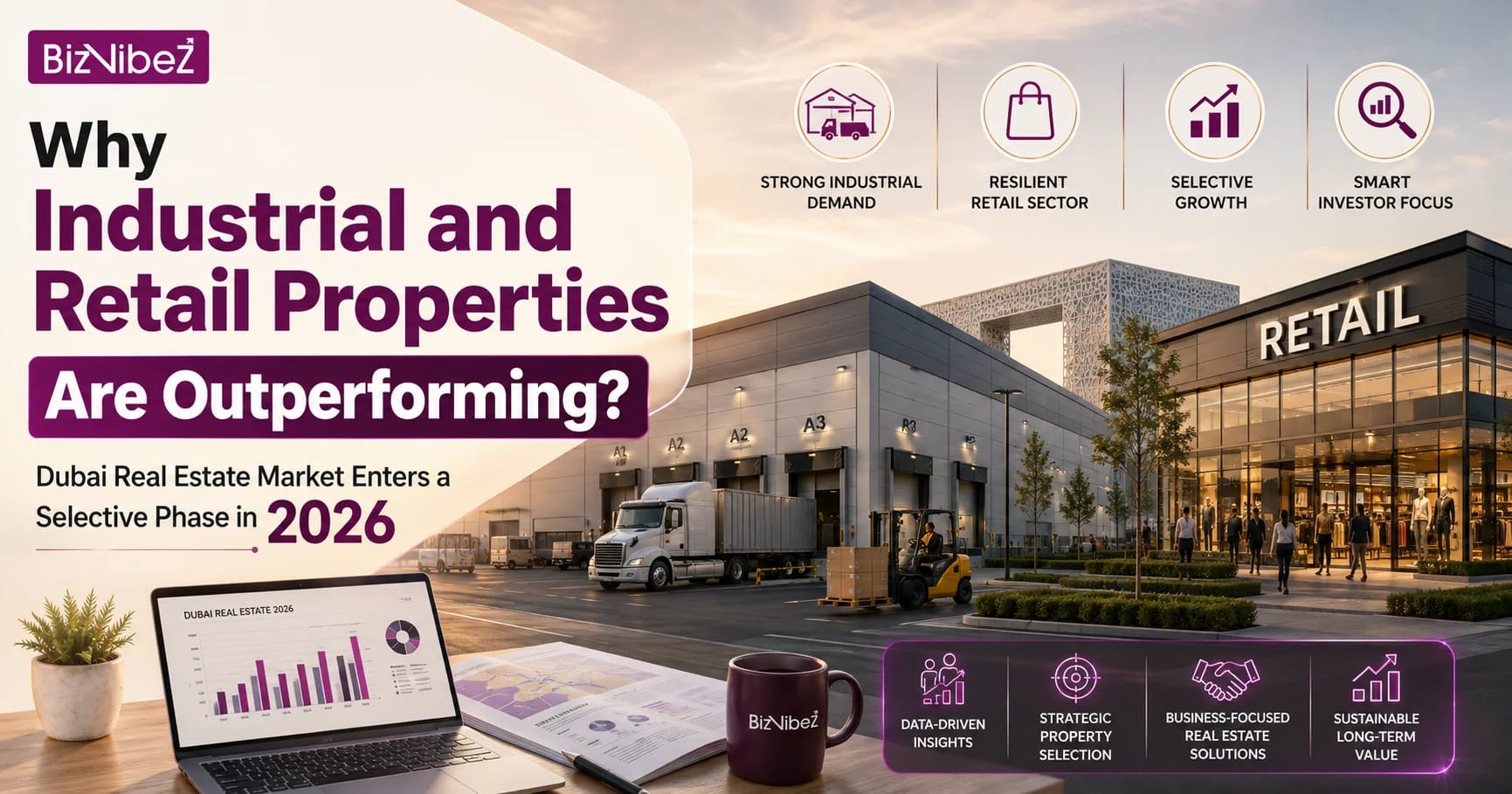
Why Industrial and Retail Properties Are Outperforming? Dubai Real Estate Market Enters a Selective Phase in 2026.
Date: 20-08-2026
Dubais real estate market has entered a more selective phase in 2026. The market is no longer moving uniformly across every property type. Industrial and logistics assets continue to benefit from tight supply and occupier demand, while retail remains resilient in well-positioned locations with strong footfall. Residential activity, meanwhile, is showing clearer signs of moderation.
CBRE reported that Dubais industrial and logistics sector remained a standout performer in Q2 2026, while retail occupancy stayed exceptionally strong despite softer tourism conditions.
The practical lesson is simple: property selection now matters more than broad exposure to Dubai real estate. Investors and businesses should assess location, tenant demand, asset quality, accessibility and future supply before making a decision. BizVibez Consultants approaches this market by examining the underlying business and property conditions rather than relying only on headline market growth.
Why is Dubai real estate becoming more selective?
Dubais overall market remains active, but performance is increasingly divided by asset type and location. Dubai Land Department reported that real estate transactions increased 6% in volume year-on-year during Q1 2026, showing continued market activity even as conditions became more measured.
This selective environment reflects several changes:
- Occupiers are becoming more careful about operational efficiency.
- Businesses continue to require strategically located industrial space.
- Retailers are prioritising locations that can demonstrate consistent customer traffic.
- Residential supply is creating greater choice for buyers and tenants.
- Investors are placing greater emphasis on asset quality and long-term usability.
The result is a market where a well-located property can perform differently from another asset in the same broad category.
Industrial property remains structurally supported
Industrial and logistics real estate has one major advantage: supply remains constrained relative to demand for suitable facilities. Dubais role as a regional trading, distribution and manufacturing hub continues to support warehouse and logistics requirements.
JLL reported that Dubai industrial rents increased 6.8% year-on-year in Q2 2026, while CBRE recorded a 12% year-on-year increase in average industrial rents during Q1. Both reports point to continued occupier demand and limited Grade A availability.
| Industrial market factor | 2026 market implication |
|---|---|
| Grade A supply | Limited availability supports demand for modern facilities |
| Logistics demand | Supported by distribution, trade and supply-chain activity |
| Location | Proximity to major transport routes improves operational efficiency |
| Building quality | Modern specifications are increasingly important to occupiers |
| New development | Future completions could gradually reduce supply pressure |
Focus on operational efficiency
Industrial property is not simply about floor area. Loading access, ceiling height, power capacity, road connectivity, yard space and building condition can directly affect how efficiently a business operates.
Before assessing an industrial property, map the daily movement of vehicles, inventory and staff. A property that appears attractive on paper can become inefficient if access routes create delays during peak operating periods.
Retail is outperforming selectively rather than universally
Retail should not be described as uniformly strong in Dubai. Tourism disruptions and changing consumer behaviour have created pressure in parts of the market. However, strong assets continue to attract occupiers and maintain high occupancy.
CBRE reported Dubai retail occupancy of approximately 98% in Q2 2026. JLL also found that Dubais citywide retail vacancy improved to 4.7%, compared with 8.0% a year earlier, with increasing demand from secondary regional and smaller-format malls.
| Retail segment | Current consideration |
|---|---|
| Prime destination malls | Strong occupancy and established customer traffic |
| Secondary malls | Improving demand where domestic consumers support footfall |
| Smaller-format centres | Can benefit from convenience-led spending |
| High-footfall locations | More attractive to retailers seeking predictable customer access |
| Weak-footfall locations | Greater risk from changing consumer behaviour |
Retail performance therefore depends heavily on tenant mix, accessibility, surrounding population and customer behaviour.
Climate and location still affect property performance
Dubais climate makes accessibility and building performance particularly important. Retail properties need comfortable indoor environments and convenient parking, while industrial facilities require ventilation, cooling and building systems suitable for high-temperature conditions.
For industrial occupiers, shaded loading areas, reliable cooling systems and appropriate worker facilities can influence productivity during the hottest months. For retail assets, covered parking, direct access and effective indoor climate control can affect customer dwell time.
Compare industrial and retail opportunities carefully
| Factor | Industrial and logistics | Retail |
|---|---|---|
| Primary demand driver | Supply chains and business operations | Consumer spending and footfall |
| Main location priority | Transport and logistics connectivity | Population, visibility and accessibility |
| Key property concern | Facility specification | Tenant mix and customer experience |
| Supply condition | Tight for quality facilities | Stronger availability varies by location |
| Main risk | Future supply and operational suitability | Weak footfall or changing consumer patterns |
| Best evaluation method | Occupier and logistics analysis | Footfall and catchment analysis |
Things to Consider Before Making a Decision
Before selecting a Dubai commercial property, examine the asset beyond current market performance.
- Study future supply: New projects can change competitive conditions around an existing property.
- Assess actual demand: Identify the businesses or consumers that will use the property.
- Check accessibility: Road connections, parking, loading access and public transport can influence usability.
- Review building quality: Modern infrastructure can reduce operational limitations.
- Consider tenant durability: A property supported by diverse occupiers may be less exposed to one business cycle.
- Separate current performance from future potential: Strong recent growth does not guarantee continued outperformance.
Relevant services available through BizVibez Consultants
- Operational Services: Practical support for business operations that depend on suitable commercial premises and efficient processes.
- Legal Services: Guidance related to legal considerations that may arise during business and property-related activities.
- Compliance Services: Support with maintaining relevant business compliance requirements while operating in the UAE.
- Bank Account Opening in UAE: Assistance with banking requirements for businesses establishing or expanding operations in the UAE.
Final Words
Dubais 2026 real estate market rewards detailed evaluation rather than blanket assumptions. Industrial properties benefit from structural occupier demand, while retail opportunities depend increasingly on location quality and proven customer activity.
The strongest decision starts with the intended use of the property, the surrounding demand and the assets ability to remain useful as market conditions change. Businesses should evaluate those factors alongside future supply before committing to a property strategy.
Discuss Your UAE Business Requirements
For businesses assessing operational, legal, compliance or banking requirements alongside a Dubai expansion decision, BizVibez Consultants can provide relevant guidance based on the specific business situation. Contact BizVibez Consultants at info@bizvibez.com or +97154248875 to discuss the requirements involved.