Dubai Retail Property Sales Surged 171%: What It Means for Commercial Real Estate Investors
Date: 06-08-2026
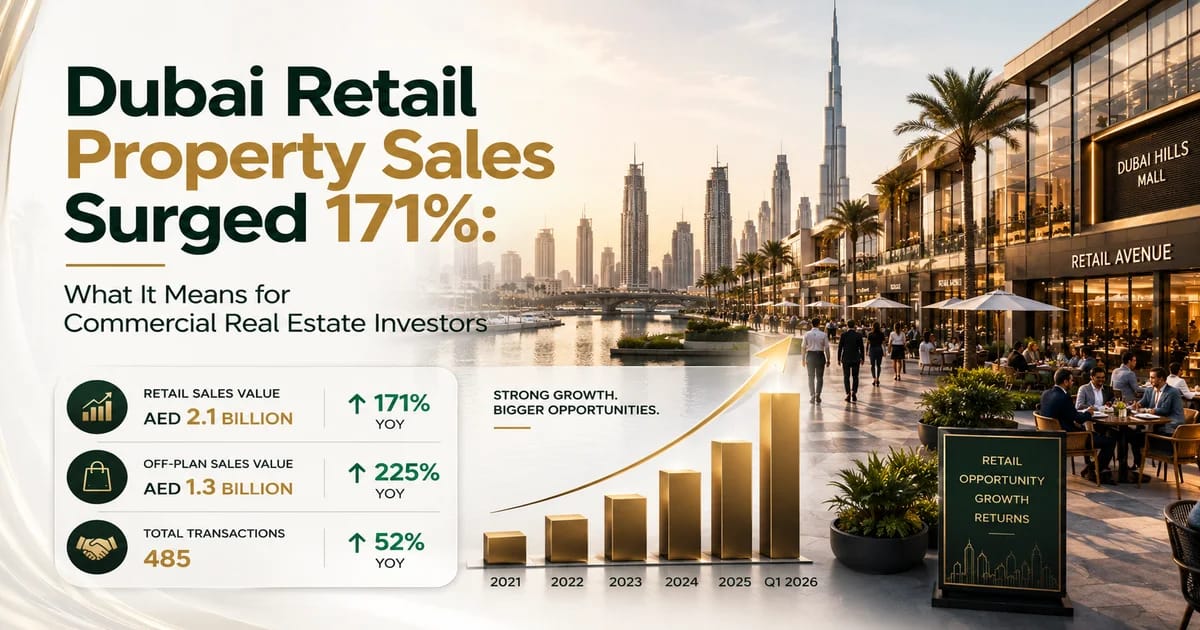
Dubai’s retail real estate sector posted one of its strongest quarters on record at the start of 2026. Sales values surged 171% year-on-year to AED 2.1 billion in Q1 2026, with off-plan retail transaction values up 225%, according to Cavendish Maxwell’s latest analysis of Dubai’s retail and warehousing sectors, published July 1, 2026.
The number of transactions reached 485, up 52% on the same quarter last year, with investors paying an average of AED 4.3 million per property, itself an 80% rise year-on-year. Off-plan retail generated over 60% of total sales values from January to March.
The surge is not a single-quarter anomaly. Off-plan retail transactions have grown eightfold in five years, from 79 deals in 2021 to nearly 740 in 2025, according to the same Cavendish Maxwell data.
This five-year trajectory confirms a structural shift in how investors perceive Dubai retail property, from a secondary asset class requiring tenant management expertise to a primary vehicle for capital growth with an off-plan payment model that mirrors residential investment patterns. This breakdown explains what is driving the surge, how retail compares to residential and office as an investment class in 2026, what the leasing data shows alongside the sales boom, and what investors must evaluate before entering the segment.
What Is Driving the 171% Sales Surge?
Three independent forces are converging to produce Q1 2026’s retail sales performance. The first is population growth. Dubai added over 208,000 new residents in 2025 alone, each requiring access to daily retail services, food and beverage, healthcare, and convenience retail within their communities. Population-driven retail demand is the most durable demand type in any market: it is not cyclical or sentiment-driven, and it compounds as each new resident establishes spending patterns that persist for years.
The second force is tourism. Dubai recorded 19.6 million international tourists in 2025, its highest annual figure, and the emirate’s tourism ambition targets 25 million visitors annually by 2030 under the D33 economic agenda. Tourist-driven retail demand concentrates in high-footfall locations, specifically malls, waterfront retail strips, and hospitality-adjacent retail, which are precisely the categories where off-plan retail launches are concentrated.
The third force is the off-plan model itself. When developers offer retail units on payment plans structured similarly to residential off-plan purchases, they lower the capital entry barrier and attract a buyer pool that previously confined itself to residential investment. The 225% surge in off-plan retail transaction values reflects the absorption of this new investor cohort into the retail market.
| Q1 2026 Retail Market Indicator | Q1 2025 | Q1 2026 | Year-on-Year Change |
|---|---|---|---|
| Total retail sales value | Baseline | AED 2.1 billion | +171% |
| Off-plan retail sales value | Baseline | AED 1.3 billion (62% of total) | +225% |
| Total retail transactions | 319 (approx.) | 485 | +52% |
| Off-plan retail transactions | 145 (approx.) | 254 | +75% |
| Average transaction value | AED 2.4 million (approx.) | AED 4.3 million | +80% |
| Retail leasing contracts (March) | Higher | 4,600 in March alone | -15% vs March 2025 |
| Rental rate movement | Baseline | Up across all locations | +16% year-on-year average |
How the Leasing Market Sits Alongside the Sales Surge?
The Q1 2026 retail leasing data tells a more nuanced story than the sales figures alone. There were 4,600 retail leasing contracts recorded in March 2026, a 15% reduction compared to March 2025. New leases fell nearly 41% year-on-year, while renewals rose 29%. Cavendish Maxwell explicitly noted that leasing activity had begun to moderate before the onset of regional uncertainty in late February 2026, indicating the pullback was a structural trend, not purely a geopolitical response.
The structural explanation is straightforward: prime retail locations in Dubai are in short supply. Established tenants in high-footfall areas are renewing rather than vacating because relocating to an equally strong position is difficult and potentially impossible in many districts. This protects existing landlords’ income streams, since a tenant who renews rather than leaves represents zero vacancy risk during the renewal period. For investors buying into established, tenanted retail, tenant stickiness is a significant income security factor.
Rental Rates Are Rising Despite Lower Transaction Volume
Average retail rental rates were more than 16% above the same period last year across Q1 2026, despite the lower leasing transaction count. This combination, fewer new leases, higher average rents, is consistent with a market where supply of top-tier space is constrained and landlords at the best addresses hold pricing power over tenants who have no comparable alternative. The rental growth story is therefore geographically concentrated: it applies to established, high-footfall locations rather than uniformly across all retail categories and communities.
How Dubai Retail Compares to Residential and Office as an Investment Class?
Retail property sits in a different investment category from residential and office, with distinct demand drivers, tenant management requirements, and risk profiles. Understanding these differences is essential before committing capital to the segment.
| Investment Factor | Retail Property | Residential Property | Office Property |
|---|---|---|---|
| Primary Demand Driver | Population growth, tourism, consumer spending | Population growth, residency preferences, end-use | Corporate migration, business expansion, economic growth |
| Q1 2026 Sales Growth | +171% year-on-year (Cavendish Maxwell) | +21.5% year-on-year (Cavendish Maxwell) | Office sales market active; DIFC Heights Tower AED 3 billion contract awarded |
| Rental Rate Trend (Q1 2026) | +16% year-on-year average | Apartment rents -2.55% YoY (REIDIN June 2026) | Average AED 238 per sq ft; balanced phase (Savills Q2 2026) |
| Tenant Profile | Brands, F&B operators, service businesses, retail chains | Individual residents, families, short-term tenants | Corporates, professional services firms, government entities |
| Vacancy Risk | Low at prime locations; high renewal rates confirm tenant retention | Higher in apartment-heavy communities with supply additions | Low in Grade A districts; softer in secondary locations |
| Off-Plan Activity | 225% YoY increase; dominant segment | 73% of Q1 residential transactions (Cavendish Maxwell) | Growing; DIFC and Business Bay leading off-plan office activity |
| Typical Investor Expertise Required | Tenant evaluation, lease terms, footfall analysis | Location and community analysis, rental yield modelling | Corporate tenant credit assessment, Grade A specification review |
What to Evaluate Before Investing in Dubai Retail Property?
The 171% sales surge reflects genuine market momentum, but retail property investment involves evaluation criteria that differ materially from residential. The following factors determine whether a specific retail investment delivers the return the headline data suggests:
- Footfall source and sustainability. A retail unit’s income depends on the volume and purchasing power of people passing through. Confirm whether the footfall driver is residential population, tourism, or corporate activity, and assess whether that driver is stable, growing, or cyclically dependent. Tourism-driven footfall concentrates in Q4 and Q1; residential-driven footfall is more consistent year-round.
- Anchor tenant strategy. In master-planned developments, anchor tenants, typically supermarkets, major F&B chains, or branded gym or wellness operators, drive footfall that benefits smaller neighbouring units. Confirm whether the anchor tenant is signed, in negotiation, or speculative before evaluating the income potential of a satellite unit in the same development.
- Permitted use classification. Dubai retail units carry permitted use classifications that specify which business categories can operate in the space. A unit classified for F&B only cannot be leased to a fashion retailer. Review the specific permitted use in the SPA and the DLD registration before purchase, as reclassification after purchase is not guaranteed and can be time-consuming.
- Leasing seasonality. Dubai’s retail activity concentrates in October through April due to climate and tourism patterns. Investor income from short-term or tourism-dependent retail tenants may be lower during June through August. Model income on a 12-month basis rather than peak-season projections alone.
- Ready versus off-plan trade-off. Off-plan retail at 225% year-on-year growth has attracted significant capital, but the off-plan retail delivery track record in Dubai is less established than in residential. Evaluate the developer’s history of delivering and successfully tenanting retail components within master developments, not just their residential delivery record.
How BizVibez Consultants Supports Commercial Property Investors?
Retail and commercial property transactions in Dubai involve business licensing, banking, legal, and compliance requirements alongside the purchase decision. BizVibez Consultants provides structured support across the most relevant areas:
- Legal Services: Review of commercial sale and purchase agreements, permitted use classifications, lease terms, and DLD registration documentation before any retail property commitment. You can also explore our professional legal services for comprehensive contract reviews and advisory.
- Bank Account Opening in UAE: Support establishing UAE banking access required to manage commercial property payments, rental income collection, and off-plan instalment schedules.
- Compliance Services: Guidance on meeting DLD, municipality, and relevant emirate regulatory requirements for commercial property ownership, permitted use, and lease registration.
- Operational Services: Support establishing the operational infrastructure required to manage a commercial property investment, including virtual office, mail management, and business licensing where relevant.
What the 171% Surge Means for Investors Evaluating Dubai Retail?
Dubai’s retail property market entered 2026 with momentum that goes beyond a single strong quarter. The eightfold increase in off-plan retail transactions over five years, the 171% year-on-year sales value surge, and the combination of rising rents with declining new leasing contracts all describe a market where supply of prime retail space is constrained, investor appetite for the asset class is structurally expanding, and established tenants are prioritising retention of existing locations over new signings.
For investors, the opportunity is real, but it requires a different evaluation framework than residential: footfall source, permitted use, anchor tenant strategy, and developer retail delivery track record matter as much as location and payment terms. Buyers who apply that framework to the current data are positioned to access a segment that is generating exceptional headline numbers for reasons that are structurally grounded rather than speculative.
Get Guidance on Your Dubai Commercial Property Decision
Legal documentation, banking access, compliance, and operational setup are the practical steps that follow any commercial property commitment in Dubai. BizVibez Consultants can be reached directly at info@bizvibez.com or +971 55 424 8875 to discuss legal review of commercial purchase terms, banking requirements, compliance obligations, or operational support relevant to a retail property investment.