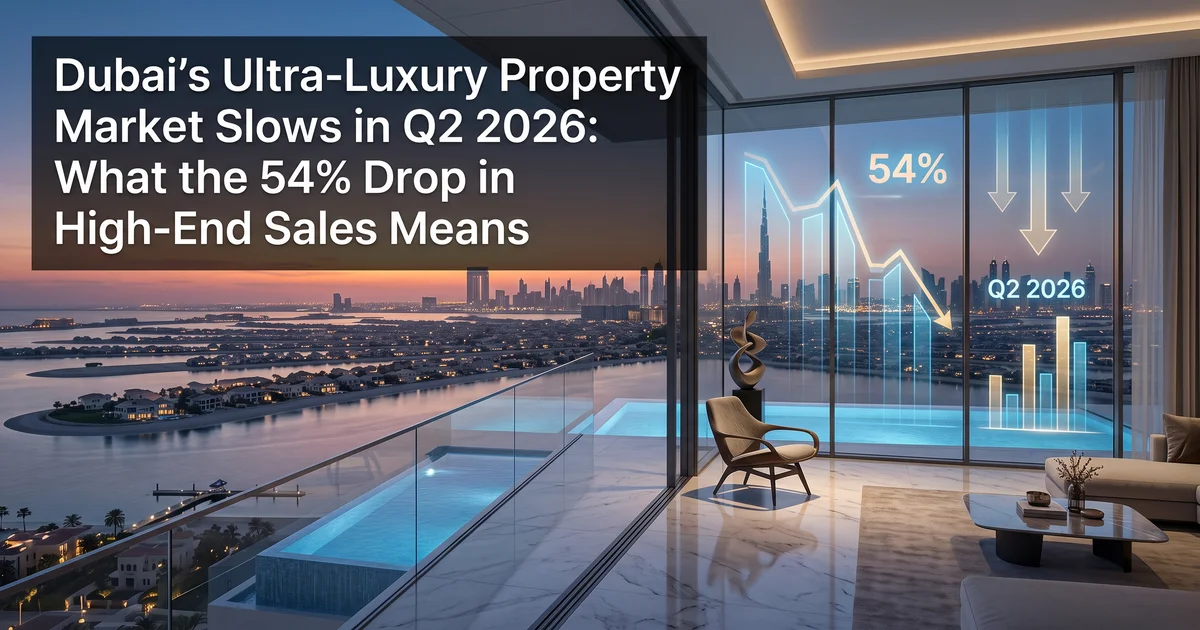
Dubais Ultra-Luxury Property Market Slows in Q2 2026: What the 54 Percent Drop in High-End Sales Means
Date: 17-07-2026
Dubai ultra-luxury residential market recorded a sharp quarterly slowdown in Q2 2026. Home sales above AED 10 million fell 54 percent compared to Q1. Transactions dropped to 864 according to data from global real estate consultancy Savills published on July 16, 2026.
The pullback is concentrated among international high-net-worth buyers from several primary regions:
- China
- Europe
- India
- Russia
These buyers drove much of the luxury boom in the emirate between 2021 and early 2026. Developers are responding in kind. They are announcing fewer new projects and extending delivery timelines. Some projects previously scheduled for three-year completion are now tracking toward four years.
The 54 percent quarter-on-quarter decline is significant. However, it does not represent a collapse of Dubai residential market overall. The broader market recorded AED 286.43 billion in H1 2026 transactions. This stands as the second-highest half-year on record.
What the Savills data reveals is a clear market bifurcation:
- The mid-market and off-plan segments remain active.
- The ultra-luxury segment is taking a pause after running at an exceptionally elevated pace through Q1.
External geopolitical uncertainty is driving this pause rather than a deterioration of Dubai structural fundamentals. This breakdown explains what the data shows, what is driving it, and what high-net-worth buyers should evaluate before acting.
What the Q2 2026 Ultra-Luxury Data Actually Shows?
The Savills threshold for ultra-luxury in Dubai is properties transacting above AED 10 million. At 864 transactions in Q2 2026, this segment is not inactive. Most global gateway cities would consider 864 transactions above 2.7 million USD in a single quarter to represent a healthy luxury market.
What makes the figure significant for Dubai is the comparison against Q1 2026. The same segment ran at approximately 1,878 transactions in Q1. That was a historically elevated pace reflecting the January 2026 record: the highest monthly transaction value in Dubai real estate history, with values up 63 percent year-on-year.
The Q2 decline therefore represents a correction from an extraordinary Q1 baseline rather than a fall from a normal operating level. The most expensive single transaction across all of H1 2026 was a six-bedroom apartment that changed hands for AED 422 million. Q2 alone included a record 26 residential transactions above AED 91.75 million. This was the highest quarterly count at that price point on record, according to Edwards and Towers. Even within a softening quarter, the absolute scale of Dubai luxury activity remains globally significant.
| Ultra-Luxury Market Indicator | Q1 2026 | Q2 2026 | Change |
|---|---|---|---|
| Transactions above AED 10 million | Approximately 1,878 | 864 | -54% quarter-on-quarter |
| Transactions above AED 91.75 million | Included in prior quarters | 26 (record quarterly count) | New record at this price tier |
| Most expensive single transaction (H1 2026) | N/A (full H1 figure) | AED 422 million | Six-bedroom apartment |
| Combined ultra-luxury H1 2026 value | AED 18.7 billion (included above) | +14% year-on-year vs H1 2025 | - |
| Developer new project pace | High; record launches | Slowing; longer timelines announced | 3-year projects extending to 4 years |
| Primary buyer nationalities affected | Chinese, European, Indian, Russian HNW | Same groups; pulling back | Geopolitical uncertainty cited |
What Is Driving the Slowdown?
The immediate catalyst is the geopolitical disruption that began on February 28, 2026, when regional conflict escalated following retaliatory action involving Iran and Gulf states. Property sales in Dubai dropped approximately 30 percent in March compared to February, according to AGBI. International buyers paused commitments in response to regional uncertainty. The luxury segment, dominated by international capital, felt this pause more acutely than the mid-market, which has a stronger base of resident end-user demand.
Fitch Ratings had already forecast a 15 percent residential price correction across the period from July 2025 through the end of 2026. This was driven by the combination of elevated new supply and post-pandemic demand normalisation.
Geopolitical disruption added a second layer of pressure specifically to the international buyer segment. Savills Q2 data shows both factors are now visible in transaction figures: supply-driven softening in mid-market apartments, and geopolitically-driven caution in the ultra-luxury tier where international buyers dominate.
Developer Response: Fewer Launches, Extended Timelines
Developers are adjusting to the shifted demand environment in two observable ways:
- New project launch announcements slowed materially in Q2 2026 compared to the record pace of Q1, when Dubai registered 250 new projects worth approximately AED 75 billion in the first five months alone.
- Projects already under development are being assigned longer delivery timelines, with some three-year completions now tracking toward four years.
This is partly a demand signal. It is also a practical response to contractor and materials competition as the elevated pipeline in the city competes for the same construction resources.
How the Ultra-Luxury Segment Compares to the Broader Market?
The Q2 ultra-luxury slowdown sits alongside a broader market that continued transacting at significant scale. Understanding how these two readings coexist requires separating buyer profile, price tier, and demand driver by segment.
| Segment | Q2 2026 Performance | Primary Buyer | Key Demand Driver | Geopolitical Sensitivity |
|---|---|---|---|---|
| Ultra-luxury (above AED 10m) | Down 54% quarter-on-quarter | International HNW: Chinese, European, Indian, Russian | Wealth preservation, tax efficiency, residency | High - international capital most exposed |
| Prime residential (AED 3m to 9.9m) | Moderate softening | Mixed: HNW residents, international buyers | Lifestyle, end-use, yield | Medium |
| Mid-market apartments | Active; yield-focused demand sustained | Resident end-users, yield investors | Rental income, off-plan payment plans | Low - resident-driven, less geopolitical |
| Off-plan (all tiers) | 72.3% of June volume; still dominant | Growth investors, first-time buyers | Payment flexibility, lower entry | Low to medium |
| Villa resale (established communities) | Prices held firmer than apartments | Family end-users, long-term holders | Supply scarcity, end-use demand | Low |
What High-Net-Worth Buyers Should Evaluate Before Acting?
The current ultra-luxury slowdown introduces a specific set of considerations that differ from those applicable in a rising market. Before committing to or deferring a high-end Dubai property transaction, weigh the following:
- Distinguish between a geopolitical pause and a structural shift. The Q2 decline is driven by external uncertainty, not by a deterioration of Dubai tax, regulatory, or residency framework. Structural factors remain intact: zero income tax, Golden Visa access, English-law compatible dispute resolution, and freehold ownership rights for foreigners. Evaluation should focus on how long external uncertainty persists rather than whether structural fundamentals have changed.
- Assess developer financial stability before committing to off-plan at this tier. Developer launches are slowing and timelines are extending. For ultra-luxury off-plan purchases, developer balance sheets, project completion track records, and escrow account confirmation carry more weight now than at a market peak.
- Check how geopolitical risk affects your specific nationality profile. The pullback is concentrated among Chinese, European, Indian, and Russian buyers. The degree of risk re-evaluation varies significantly by origin market. Buyers from markets not directly affected by friction may find the competitive environment in Dubai luxury segment more accessible than in Q1.
- Evaluate the Golden Visa timing question. The AED 2 million Golden Visa threshold sits well below the ultra-luxury tier. Buyers evaluating larger transactions should assess whether a phased approach better matches the current environment. Securing residency through a qualifying property first while evaluating the ultra-luxury market across a longer timeframe provides flexibility.
- Review title transfer and contract terms with independent legal counsel. Under the UAE Civil Transactions Law effective June 1, 2026, pre-contractual disclosure obligations and reservation agreement terms carry different legal weight than before. Any ultra-luxury transaction signed or renegotiated after this date requires independent legal review against the updated framework.
How BizVibez Consultants Supports High-Net-Worth Buyers?
High-end property transactions in Dubai involve residency, legal, compliance, and banking requirements that sit alongside the investment decision. BizVibez Consultants provides structured support across key operational areas:
- Golden Visa UAE: Guidance on 10-year UAE residency eligibility tied to qualifying property investment thresholds.
- Legal Services: Review of sale and purchase agreements, reservation terms, and title documentation under the current regulatory framework including the June 2026 Civil Transactions Law update.
- Bank Account Opening in UAE: Support establishing UAE banking infrastructure required for high-value property payments, rental income management, and wealth management operations.
- Compliance Services: Ongoing alignment with Dubai Land Department requirements and federal regulatory obligations across property ownership, transfer, and income structures.
What Does This Data Mean for Anyone Evaluating Dubai Luxury Property?
Dubai 54 percent quarterly drop in ultra-luxury sales reflects a real pause rather than a structural reversal. It is driven by external geopolitical uncertainty affecting the international buyer segment that dominates transactions above AED 10 million. This occurs alongside a broader market moderating from an exceptional Q1 pace.
The structural advantages of the emirate remain intact: tax efficiency, freehold ownership, Golden Visa residency access, and an improving regulatory framework. What has changed is the competitive and sentiment environment in the ultra-luxury tier. The evaluation framework for any high-end Dubai property decision in H2 2026 must explicitly account for developer stability, contract terms under the updated civil law, and a realistic holding horizon.
Get Structured Guidance on Your Dubai Property Decision
Evaluating a high-end Dubai property transaction during a market pause raises specific questions about residency, legal documentation, banking, and compliance. BizVibez Consultants can be reached directly at info@bizvibez.com or +971 55 424 8875 to discuss Golden Visa eligibility, legal review of purchase terms, or banking requirements relevant to a luxury property transaction in the current market.