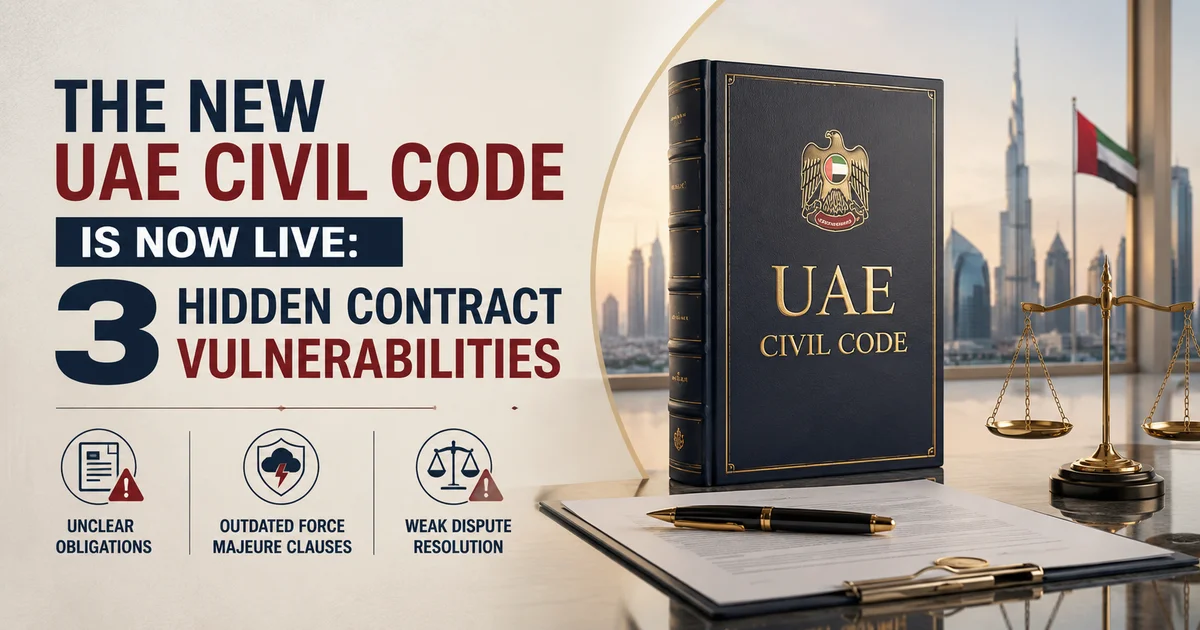
The New UAE Civil Code Is Now Live: 3 Hidden Contract Vulnerabilities
Date: 10-07-2026
The updated UAE Civil Code changes how many contractual obligations are interpreted and enforced, making contract reviews a priority for businesses operating in Dubai during 2026. Companies that continue relying on outdated templates or loosely drafted agreements may face unnecessary disputes, delayed enforcement, or unintended legal obligations.
This article explains three overlooked contract vulnerabilities that deserve immediate attention, along with practical steps to reduce legal risk before signing new agreements. The guidance reflects practical contract management experience and aligns with commonly accepted legal compliance practices used across UAE businesses. It is intended for educational purposes and should not replace legal advice for specific cases.
Understand why existing contracts deserve another review
Many businesses assume contracts signed before the new Civil Code automatically remain fully protected without further assessment. While valid agreements generally continue to apply, certain clauses may now be interpreted differently under updated legal principles.
Businesses should review contracts involving:
- Long-term commercial relationships
- Service agreements
- Supplier contracts
- Partnership arrangements
- Employment-related commercial obligations
- Distribution agreements
According to the World Bank, predictable contract enforcement remains one of the strongest factors influencing business confidence and investment decisions. Regular legal reviews improve commercial certainty and reduce dispute risks.
Identify the three hidden contract vulnerabilities
Unclear performance obligations
Many contracts describe responsibilities using broad language instead of measurable obligations. Phrases such as "reasonable efforts," "timely completion," or "acceptable quality" often create room for disagreement.
Under the updated legal framework, courts may examine:
- Industry standards
- Conduct of both parties
- Commercial expectations
- Good faith obligations
The more precise the wording, the lower the likelihood of conflicting interpretations.
Outdated force majeure clauses
Many contracts still use force majeure wording drafted several years ago without considering recent legal developments or modern business risks.
Businesses should verify whether contracts clearly define:
- Government restrictions
- Regulatory changes
- Supply chain interruptions
- Technology failures
- Cross-border operational disruptions
Weak dispute resolution provisions
Dispute clauses often receive little attention during negotiations, yet they become critical when disagreements arise.
Common weaknesses include:
- No governing law specified
- No jurisdiction identified
- Missing mediation procedures
- Unclear arbitration language
- Conflicting notice requirements
Strong dispute resolution clauses frequently shorten legal proceedings and improve enforceability.
Compare strong contracts with vulnerable agreements
| Key Contract Area | Higher Risk Agreement | Stronger Agreement |
|---|---|---|
| Performance obligations | General wording | Clearly measurable duties |
| Deliverables | Broad expectations | Detailed specifications |
| Deadlines | Approximate timelines | Defined milestones |
| Force majeure | Generic wording | Event-specific definitions |
| Amendments | Informal changes | Written approval process |
| Dispute resolution | Missing jurisdiction | Clearly defined legal process |
| Notice requirements | Unspecified | Detailed communication procedures |
Contract elements that deserve immediate attention
| Contract Element | Reason for Review | Recommended Practice |
|---|---|---|
| Scope of work | Prevents scope disputes | Define deliverables precisely |
| Payment conditions | Reduces interpretation conflicts | Link payments to milestones |
| Termination clauses | Clarifies exit rights | Include objective triggers |
| Liability provisions | Allocates commercial risk | Define reasonable limitations |
| Governing law | Supports enforcement | Confirm applicable UAE law |
| Record keeping | Strengthens evidence | Maintain documented approvals |
Review contracts before signing new agreements
Businesses entering new commercial relationships during 2026 should evaluate more than legal wording alone.
Important review points include:
- Whether every obligation can be objectively measured.
- Whether approval procedures are documented.
- Whether contract amendments require written confirmation.
- Whether compliance obligations reflect current UAE regulations.
- Whether all parties understand operational responsibilities.
Businesses operating across multiple Emirates should also verify that contracts remain suitable for their licensing structure and regulatory environment.
Consider these factors before making contractual decisions
Before approving any commercial agreement, decision-makers should evaluate several practical considerations rather than focusing only on commercial terms.
| Decision Factor | Why It Matters |
|---|---|
| Business structure | Different legal entities may have different obligations. |
| Contract duration | Longer agreements usually require greater flexibility. |
| Cross-border activities | International transactions may involve additional legal considerations. |
| Regulatory compliance | Industry-specific rules may affect contractual obligations. |
| Documentation process | Proper record management strengthens future enforcement. |
The Organisation for Economic Co-operation and Development (OECD) consistently highlights effective legal certainty and contract governance as essential components of sustainable business environments.
Immediate questions businesses often ask before reviewing contracts
Should every existing contract be reviewed?
Not necessarily. Priority should be given to long-term agreements, high-value contracts, strategic supplier arrangements, and contracts renewed during 2026.
Is a template downloaded several years ago still suitable?
Only after confirming it reflects current legal requirements and accurately matches the intended business relationship.
Who should participate in a contract review?
Legal professionals, operational managers, finance teams, and decision-makers should review contracts together to ensure both legal compliance and operational practicality.
Business support available through BizVibez Consultants
BizVibez Consultants supports businesses by helping maintain strong operational and regulatory practices throughout the company lifecycle.
- Legal Services: Guidance on commercial documentation, regulatory requirements, and contract-related compliance matters.
- Compliance Services: Assistance with maintaining ongoing regulatory obligations and corporate governance.
- PR Services: Support for government documentation and administrative procedures connected with business operations.
- Operational Services: Practical assistance with maintaining organised business processes that support contractual compliance.
Final thoughts
The updated UAE Civil Code makes careful contract drafting more important than ever. Businesses that define obligations clearly, strengthen dispute clauses, and review existing agreements regularly place themselves in a stronger position to reduce legal uncertainty. Every commercial relationship should be supported by contracts that accurately reflect current operations and applicable legal requirements.
Speak with BizVibez Consultants
Businesses seeking guidance on commercial documentation, compliance processes, or operational governance can contact BizVibez Consultants for educational support regarding UAE business requirements. For further information, reach out at info@bizvibez.com or call +971 55 424 8875 to discuss the most appropriate compliance approach for your business circumstances.