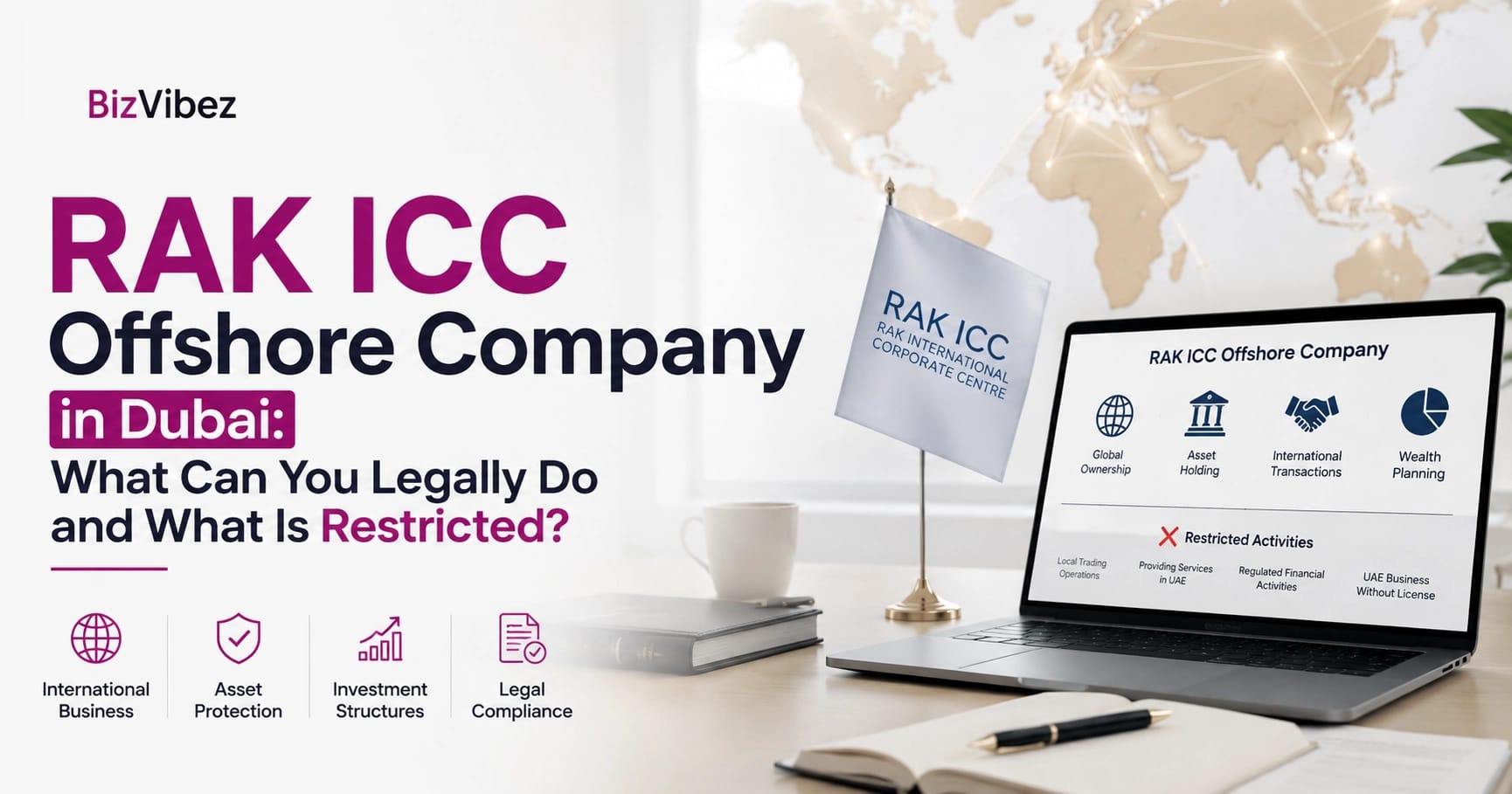
RAK ICC Offshore Company in Dubai: What Can You Legally Do and What Is Restricted?
Date: 02-09-2026
A RAK ICC offshore company can be used for international holding structures, ownership of assets, investment arrangements, succession planning and cross border business structures. It can also hold UAE or overseas assets where the applicable ownership rules permit it. However, a RAK ICC company is not automatically licensed to conduct ordinary commercial operations in Dubai or elsewhere in the UAE. Carrying out a regulated or operational business inside the UAE generally requires the appropriate local licence and compliance with the relevant authority.
This distinction is critical when evaluating an offshore company in Dubai. RAK ICCs own regulations state that a company cannot carry on business in the UAE outside the RAK ICC zone unless it first obtains the appropriate licences and complies with applicable UAE laws. RAK ICC also operates under UAE federal and Ras Al Khaimah laws and does not permit illegal activities.
What a RAK ICC Offshore Company Can Legally Do
The practical value of a RAK ICC structure lies mainly in ownership, investment and international structuring rather than operating a conventional Dubai business.
RAK ICC identifies holding companies, special purpose vehicles, family office structures, joint ventures, project companies and international business companies among its potential uses. Its company structures can also hold real estate and other assets, subject to the laws governing those assets.
| Permitted use | What it means in practice | Key condition |
|---|---|---|
| Holding investments | Hold shares, securities or interests in other entities | Follow applicable ownership and investment rules |
| Asset holding | Own eligible assets or property | UAE asset ownership rules still apply |
| International transactions | Structure business relationships outside the UAE | The relevant foreign jurisdiction must permit the activity |
| Special purpose vehicle | Isolate a particular project or asset | Corporate documents should reflect the intended purpose |
| Family wealth structuring | Support succession and asset ownership arrangements | Tax, inheritance and beneficial ownership rules must be reviewed |
| Joint venture structure | Participate in an international corporate arrangement | Underlying business must comply with applicable laws |
What an Offshore Company Cannot Simply Do in Dubai
The biggest misunderstanding is treating an offshore registration as equivalent to a Dubai commercial licence. It is not.
A RAK ICC offshore company cannot simply open a shop, provide professional services from Dubai, employ staff for a UAE operating business or conduct locally regulated activities merely because the company is incorporated in the UAE. The required licence depends on the actual activity and the jurisdiction in which that activity takes place.
| Activity in Dubai or the UAE | RAK ICC offshore registration alone | Additional requirement |
|---|---|---|
| Running a local trading operation | Not sufficient | Appropriate commercial licence |
| Providing consultancy services locally | Not sufficient | Relevant professional or service licence |
| Opening a physical operating office | Does not itself authorise operations | Appropriate business and premises approvals |
| Conducting regulated financial activities | Not sufficient | Sector specific regulatory authorisation |
| Employing staff for UAE operations | Not automatically authorised | Appropriate establishment and labour related registrations |
| Conducting business outside the UAE | Generally possible within the structure | Licensing and laws of the destination jurisdiction apply |
The RAK ICC regulations expressly place responsibility on the company to obtain the necessary UAE licences before conducting business outside the RAK ICC zone.
The Structure Matters More Than the Registration Label
An offshore company should be assessed according to what it actually does, where management and operations occur, who owns it and where income is generated.
RAK ICC provides several structures, including companies limited by shares, companies limited by guarantee, restricted purposes companies, segregated portfolio companies and unlimited companies. A restricted purposes company is particularly useful where the corporate documents need to limit the entity to defined purposes.
Key technical points to check
| Technical factor | Practical relevance |
|---|---|
| Corporate purpose | Determines what the company is established to undertake |
| Registered agent | RAK ICC incorporation is conducted through registered agents |
| Beneficial ownership | Ownership and control information must meet applicable UAE requirements |
| Economic substance | Relevant activities can trigger additional substance and reporting considerations |
| Local licensing | Required when the company conducts business within the UAE outside the permitted corporate framework |
| Tax position | Depends on activities, income, residence and applicable UAE tax rules |
RAK ICCs current regulatory framework includes the Business Companies Regulations 2018 and related compliance policies.
Tax Compliance Still Applies
Offshore status should not be confused with automatic tax exemption. The UAEs Corporate Tax framework applies according to the companys status and activities. The official UAE Government platform currently states that taxable income is subject to 0% up to AED 375,000 and 9% above that threshold, subject to the rules and exemptions applicable to the taxpayer.
The Federal Tax Authority also confirms that taxable persons must register for Corporate Tax in accordance with the applicable law and implementing decisions.
RAK ICC also identifies relevant activities for Economic Substance requirements, including holding company, headquarters, intellectual property, shipping, insurance, banking, investment fund management, lease finance and distribution and service centre activities.
RAK ICC Offshore Compared With a UAE Operating Structure
| Factor | RAK ICC offshore company | UAE operating company |
|---|---|---|
| Primary purpose | Holding and international structuring | Conducting licensed business |
| Dubai commercial operations | Not authorised by offshore registration alone | Possible with the appropriate licence |
| Local office operations | Requires separate legal basis where applicable | Supported by the operating licence |
| International ownership | Suitable for international structures | Also possible subject to applicable rules |
| Local regulatory approvals | Activity dependent | Usually required for the licensed activity |
| Typical use | Holding, SPV, investments and asset structuring | Trading, services, manufacturing and local operations |
RAK ICC itself offers a separate Global Product for businesses requiring commercial, services, e-commerce, media or educational activities, while its Premium Product combines a RAK ICC holding company with a RAKEZ operating subsidiary. This illustrates the practical distinction between a holding structure and a UAE operating entity.
Things to Consider Before Choosing the Structure
Before proceeding, examine:
- Where customers are located: UAE customers can change the licensing and tax analysis.
- Where the work is performed: Conducting actual operations in Dubai is different from holding an overseas investment.
- Whether the activity is regulated: Financial, insurance, professional and other regulated activities can require additional approvals.
- How the company will be managed: Management and decision making can affect tax and substance considerations.
- What the company will own: Property, intellectual property, shares and other assets can have different legal requirements.
- Whether a UAE operating subsidiary is more appropriate: A holding company and an operating company can serve different purposes within the same group.
Relevant Support Available From BizVibez Consultants
For structures involving UAE corporate administration and compliance, the most relevant services include:
- Bank Account Opening in UAE: Supports the documentation and practical preparation required when establishing a suitable UAE banking relationship.
- Compliance Services: Helps businesses maintain corporate information and ongoing regulatory requirements.
- Legal Services: Useful when reviewing corporate structures, agreements and activity specific legal considerations.
- Operational Services: Supports administrative requirements where a structure involves ongoing UAE business functions.
Maintaining the Structure After Incorporation
An offshore company requires ongoing attention rather than a one time registration exercise. Corporate records, beneficial ownership information, registered agent requirements, tax obligations and any relevant economic substance considerations should remain aligned with the companys actual activities.
RAK ICCs regulatory framework has also continued to evolve alongside wider UAE compliance requirements. Its federal announcements currently reference beneficial ownership procedures, anti money laundering legislation and other federal compliance measures.
Make the Structure Match the Business
A RAK ICC offshore company works best when its legal purpose matches its actual use. Holding investments, owning eligible assets and structuring international relationships can fit the model, while running a conventional Dubai business requires the appropriate operating licence.
The safest approach is to define the intended activity, operating location, ownership structure and compliance obligations before selecting the corporate vehicle.
Discuss Your Specific Structure
For practical guidance on the UAE side of an offshore structure, leveraging professional legal services ensures full compliance and proper documentation. BizVibez Consultants can be contacted at info@bizvibez.com or +971 44 569 917. The appropriate structure should be assessed against the companys actual activities, ownership and long term operating requirements rather than the registration label alone.