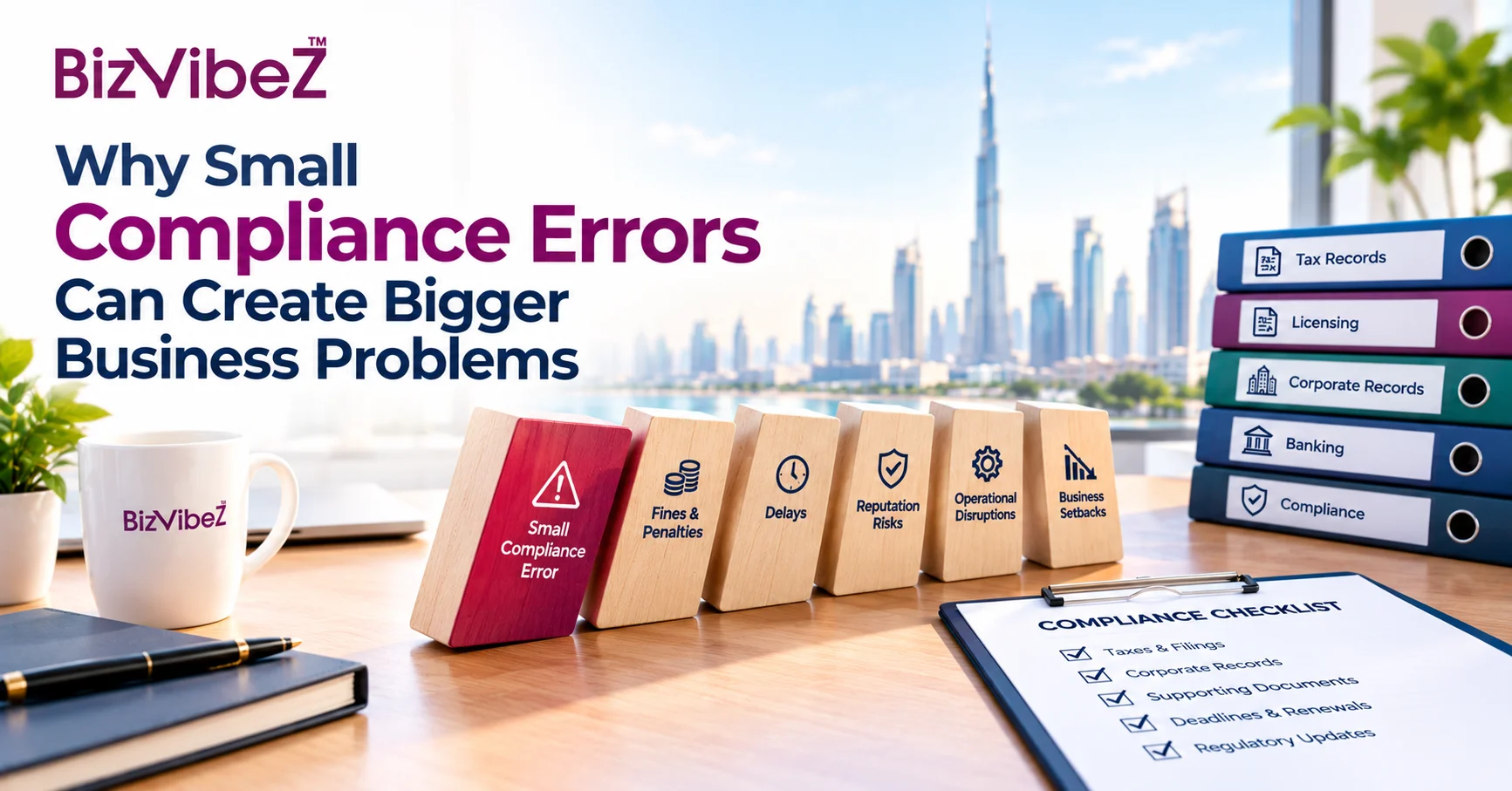
Why Small Compliance Errors Can Create Bigger Business Problems
Date: 09-09-2026
Small compliance errors rarely remain small. A missed filing date, outdated company record, incomplete supporting document, or incorrect tax information can trigger follow-up actions that affect several parts of a business at once. The safest approach is to identify obligations early, maintain accurate records, assign responsibility for each deadline and review changes before they become formal compliance failures.
In the UAE, this matters because regulatory oversight continues to become more structured. The Federal Tax Authority reported 103,680 field inspection visits during the first half of 2026, a 21% increase from the same period in 2025, showing that compliance checks are an active part of the business environment. Practical compliance work therefore needs to focus not only on correcting mistakes but also on preventing small administrative gaps from becoming larger operational problems.
How a Minor Compliance Error Becomes a Business Problem
A compliance issue often develops through several connected steps rather than one major failure. For example, an incorrect business record can lead to inconsistent information across tax filings, licensing records, banking documents, and internal accounts.
| Small compliance error | Possible immediate issue | Potential wider business impact |
|---|---|---|
| Missed filing deadline | Late submission | Penalties, follow-up notices, additional administrative work |
| Incorrect tax information | Return requires correction | Reconciliation problems and possible penalties |
| Outdated company information | Records no longer match | Delays during verification or official processes |
| Missing supporting documents | Filing cannot be properly substantiated | Difficulty responding to authority requests |
| Incomplete beneficial ownership information | Corporate records become inconsistent | Additional compliance review |
| Poor document tracking | Deadlines or renewals are missed | Operational disruption and repeated corrective work |
The important point is that compliance should be treated as a connected business process. Fixing one document after an error appears may not resolve the related records, filings, or internal controls.
The Compliance Areas Small Businesses Commonly Overlook
Tax records and filing deadlines
Tax compliance is not limited to submitting a return. Businesses must also retain records that support the information reported to the Federal Tax Authority. The FTA specifically states that taxable persons should maintain financial statements and supporting records for information included in Corporate Tax returns and other filings.
A business that keeps incomplete records may therefore face a problem even when the final tax return appears correct.
The FTA also confirmed in September 2026 that Corporate Tax returns and applicable payments must generally be completed within nine months from the end of the relevant Tax Period.
Corporate information and ownership records
Changes to shareholders, managers, business activities, contact details, or beneficial ownership information should not be treated as isolated administrative updates. Different authorities and internal records may depend on the same underlying information.
The UAE Ministry of Economy identifies beneficial-owner procedures and AML requirements as part of the countrys regulatory framework, including Cabinet Decision No. 109 of 2023 concerning beneficial-owner procedures.
Supporting documentation
A common weakness is maintaining only the final submitted document instead of the evidence behind it. Contracts, invoices, transaction records, asset information, accounting records, and corporate documents can become important when an authority needs to verify an entry.
The FTA has explicitly stated that failure to maintain required records can result in administrative penalties under applicable tax legislation.
What Good Compliance Control Looks Like
Effective compliance does not require complicated systems. It requires clear ownership, accurate information, documented evidence, and regular checks.
| Control area | Practical control | Recommended review point |
|---|---|---|
| Deadlines | Central compliance calendar | Monthly |
| Corporate records | Match official and internal records | After every company change |
| Tax documentation | Reconcile filings with accounting records | Before submission |
| Supporting evidence | Maintain organised digital records | Monthly or quarterly |
| Regulatory changes | Check relevant authority updates | Monthly |
| Responsibility | Assign an accountable person to each obligation | At the start of each reporting cycle |
The strongest process also separates preparation from review where practical. A second person checking dates, figures, names, and attachments can identify simple mistakes before submission.
Why Record Accuracy Matters More Than Businesses Expect
An incorrect figure or outdated document can create a chain of inconsistencies. For example, if accounting records contain one transaction classification while the tax return uses another, correcting the return may require additional reconciliation and supporting evidence.
The UAE tax environment also continues to evolve. The FTAs Corporate Tax legislation database lists new 2026 decisions and clarifications, including updated registration and compliance requirements.
This makes periodic review important even when a business has not changed its core activity.
Practical Steps to Prevent Small Errors
A workable compliance routine can follow five steps:
- Identify every recurring obligation linked to the companys activities.
- Assign responsibility instead of leaving deadlines to general management.
- Keep source documents organised so every filing can be supported.
- Review changes immediately when ownership, management, activities, or business information changes.
- Document completed submissions with confirmation records and relevant correspondence.
A useful internal rule is simple: no compliance task should depend on memory alone.
Things to Consider Before Making a Decision
Before selecting a compliance process, consider the actual structure and activities of the business rather than copying another companys system.
| Decision factor | Question to assess | Why it matters |
|---|---|---|
| Business structure | Which authority and regulations apply? | Obligations differ by business structure and activity |
| Tax status | Which tax registrations and filings apply? | Incorrect assumptions can create missed obligations |
| Business activity | Does the activity create additional regulatory requirements? | Some sectors have specific compliance controls |
| Record volume | How many transactions and documents require tracking? | Manual controls become harder to maintain as volume grows |
| Internal responsibility | Who reviews each submission? | Clear accountability reduces missed deadlines |
| Regulatory changes | How will new requirements be monitored? | Rules and guidance can change over time |
How BizVibez Consultants Supports Compliance Work
BizVibez Consultants approaches compliance as an organised business process rather than a last-minute corrective task. Relevant services include:
- Compliance Services — Supports the organisation and monitoring of recurring business compliance requirements and documentation.
- Accounting & Support — Helps maintain accurate business records that can support regulatory and tax requirements.
- Legal Services — Assists with business documentation and legal matters where formal review is required.
- Operational Services — Helps businesses maintain administrative processes that support consistent day-to-day compliance.
The appropriate support depends on the companys [company's] structure, activities, registrations, and existing internal controls.
Maintaining Compliance Over the Long Term
Good compliance is built through repeatable habits. Businesses that maintain accurate records, monitor deadlines, review changes promptly, and retain supporting evidence are better positioned to identify problems before they become larger administrative or regulatory issues.
The objective is not to create unnecessary paperwork. It is to make important obligations visible, assign responsibility, and create enough evidence to demonstrate that each requirement was handled properly.
Discuss Your Compliance Requirements
For businesses reviewing an existing compliance process or trying to identify gaps, BizVibez Consultants can provide information about relevant compliance and operational support. For a specific enquiry, contact +971 54 201 9999 or info@bizvibez.com and provide the business structure, activity, and compliance area requiring attention.