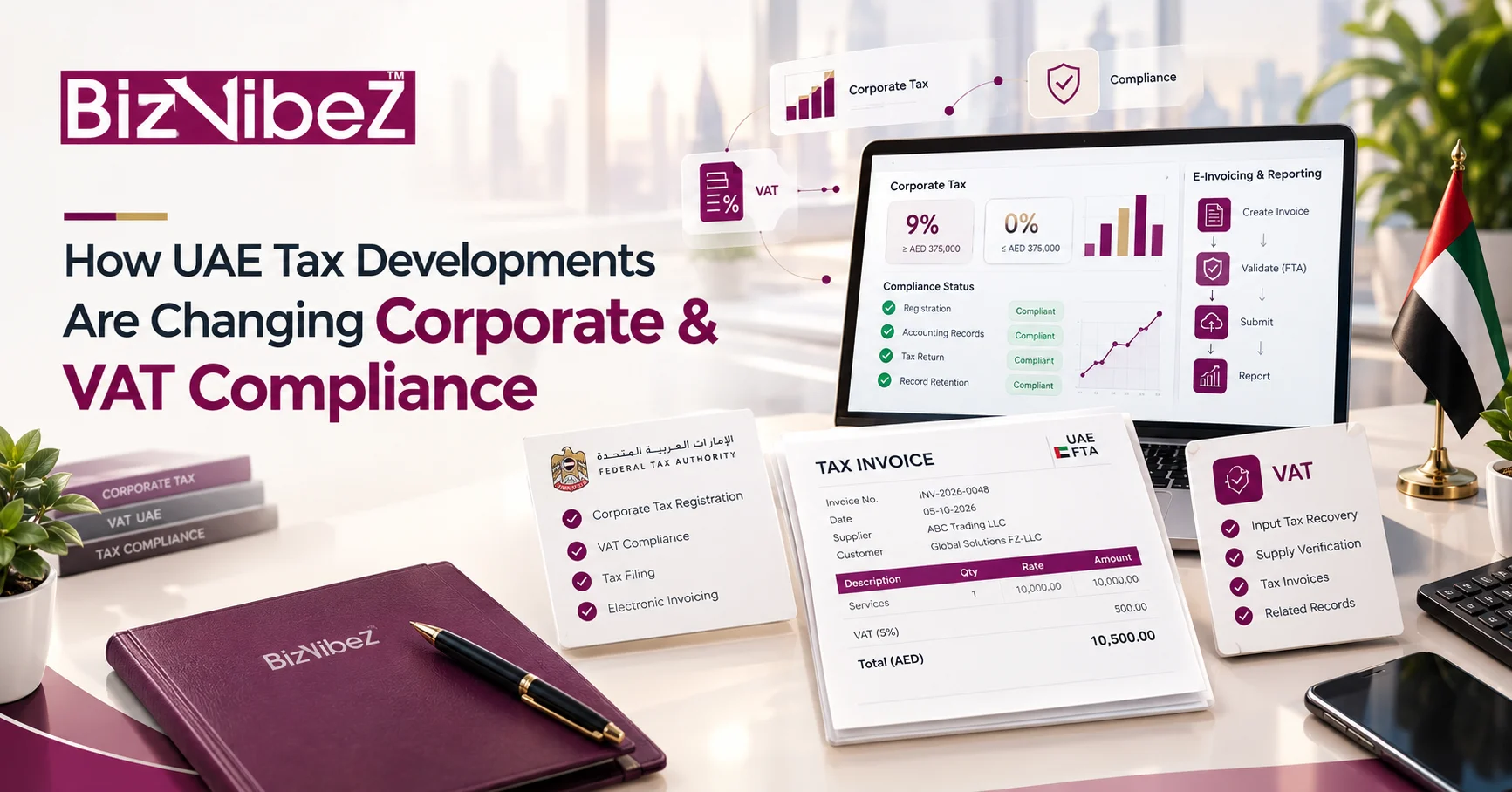
How UAE Tax Developments Are Changing Corporate & VAT Compliance
Date: 05-10-2026
UAE tax compliance is moving from periodic filing toward continuous data accuracy, stronger transaction controls, and increasingly digital reporting. Corporate Tax now requires taxable businesses to maintain reliable accounting records, register with the Federal Tax Authority, determine taxable income correctly, and meet filing deadlines. VAT compliance is also becoming more detailed as the FTA issues new rules on input tax recovery, supply verification, tax invoices, and related records.
The most significant operational change is the UAEs electronic invoicing programme. Businesses must prepare their accounting and invoicing systems for structured electronic invoices rather than relying on PDFs or scanned documents. The current framework also creates phased implementation deadlines, making tax compliance increasingly dependent on the quality of underlying business data.
BizVibez Consultants approaches UAE tax compliance through practical checks of registrations, accounting records, invoices, transaction classifications, and filing processes. This helps businesses identify compliance gaps before they become filing or audit problems.
What Has Changed In UAE Corporate Tax Compliance
Corporate Tax is no longer simply a year-end calculation. Businesses need a consistent process for capturing revenue, expenses, adjustments, supporting documents, and tax-sensitive transactions throughout the financial year.
The UAE Corporate Tax framework generally applies a 0% rate to taxable income up to AED 375,000 and 9% to taxable income exceeding AED 375,000. Small Business Relief has also been extended for eligible taxable persons to tax periods ending on or before 31 December 2029, subject to the applicable conditions.
The practical implication is that businesses should not wait until the tax return is due to determine whether their records support the tax position.
Current Corporate Tax Compliance Requirements
| Compliance area | What businesses need to monitor | Practical implication |
|---|---|---|
| Corporate Tax registration | Registration requirements and prescribed timelines | Maintain an active FTA profile and monitor changes in status |
| Accounting records | Income, expenses, adjustments and supporting evidence | Keep records that can support the tax return |
| Taxable income | Accounting results and Corporate Tax adjustments | Reconcile accounting profit with taxable income |
| Tax return | Correct reporting within the prescribed deadline | Complete reconciliation before submission |
| Small Business Relief | Revenue threshold and eligibility conditions | Confirm eligibility for each relevant tax period |
| Record retention | Required accounting and commercial records | Maintain an organised audit trail |
The FTA reported that 30 September 2026 is the deadline for Corporate Tax returns and payment for taxable persons whose tax period ended on 31 December 2025.
VAT Compliance Is Becoming More Evidence Driven
Recent FTA developments show that VAT compliance increasingly depends on proving that transactions are genuine, correctly documented, and properly classified.
The FTAs 2026 VAT legislation includes new measures covering verification of the validity and integrity of supplies and conditions for recovering input VAT on employee expenses. The Executive Regulation of the VAT Decree-Law was also updated in September 2026.
For UAE-resident businesses, mandatory VAT registration remains linked to taxable supplies and imports exceeding AED 375,000 over the previous 12 months or expected to exceed that amount within the next 30 days. Voluntary registration remains available above AED 187,500 subject to the applicable rules.
Key VAT Thresholds And Compliance Points
| Item | Current requirement |
|---|---|
| Mandatory VAT registration threshold | AED 375,000 |
| Voluntary VAT registration threshold | AED 187,500 |
| Mandatory threshold measurement | Previous 12 months or expected next 30 days |
| Non-resident businesses | Special registration rules can apply regardless of the threshold |
| Input VAT recovery | Must satisfy applicable recovery conditions and supporting evidence |
Businesses should therefore review not only whether VAT was charged correctly but also whether purchase invoices, contracts, payment evidence, and transaction records support input.
Electronic Invoicing Is Changing The Compliance Workflow
Electronic invoicing represents a major shift because invoice information will move through structured digital channels rather than being treated simply as a document.
The Ministry of Finance states that PDFs, Word documents, images, scanned invoices and email attachments are not eInvoices under the UAE framework. The national system uses the Peppol-based four-corner model to support electronic invoice exchange and reporting.
The current implementation timeline is phased.
| Business category | Accredited Service Provider deadline | Implementation date |
|---|---|---|
| Revenue of AED 50 million or more | 30 October 2026 | 1 January 2027 |
| Revenue below AED 50 million | 31 March 2027 | 1 July 2027 |
| In-scope government entities | 31 March 2027 | 1 October 2027 |
The AED 50 million ASP deadline was extended from July to 30 October 2026 through Ministerial Decision No. 66 of 2026.
This means businesses should assess accounting software, invoice fields, customer and supplier master data, tax coding, integration capabilities, and internal approval workflows before implementation.
Compare The Compliance Priorities Before Updating Systems
| Compliance priority | Best suited for | Main focus |
|---|---|---|
| Corporate Tax review | Taxable businesses | Registration, taxable income, records and filing |
| VAT health check | VAT-registered businesses | Tax invoices, input tax, output tax and transaction evidence |
| eInvoicing readiness | Businesses entering the phased rollout | ERP capability, structured invoice data and integration |
| Combined review | Businesses subject to both regimes | Consistency between accounting, VAT and Corporate Tax records |
Things To Consider Before Making A Decision
Before changing accounting or tax processes, businesses should examine:
- Whether Corporate Tax and VAT registrations accurately reflect the current business structure.
- Whether accounting records can distinguish taxable, exempt, zero-rated and non-taxable transactions where relevant.
- Whether supplier and customer records contain the information needed for accurate tax treatment.
- Whether contracts match the tax treatment applied to invoices.
- Whether the accounting platform can support future structured eInvoicing requirements.
- Whether branches, free-zone activities, related entities and tax groups have been reviewed separately where applicable.
A useful approach is to test several recent transactions from source document to accounting entry, VAT treatment, and eventual tax reporting. This exposes process gaps that a simple registration review may not identify. For complex cross-border contracts or corporate restructuring, consulting professional legal services ensures regulatory alignment.
How BizVibez Consultants Supports Relevant Compliance Needs
For businesses reviewing the operational side of UAE tax compliance, the most relevant services include:
- Compliance Services — Supports structured reviews of business compliance requirements and documentation.
- Operational Services — Helps businesses organise administrative processes that affect ongoing record accuracy.
- Legal Services — Relevant when contractual or corporate documentation needs review alongside compliance requirements.
- Bank Account Opening in UAE — Supports businesses where banking documentation forms part of broader corporate administration and record keeping.
Review Your UAE Tax Compliance Process
UAE tax compliance now requires businesses to connect accounting accuracy with VAT controls, Corporate Tax reporting and digital invoicing readiness. Businesses should review their current processes against the latest applicable FTA and Ministry of Finance requirements rather than relying on older procedures.
For practical compliance support, BizVibez Consultants can be contacted at info@bizvibez.com or +971 44 569 917 to discuss the specific requirements affecting a business.