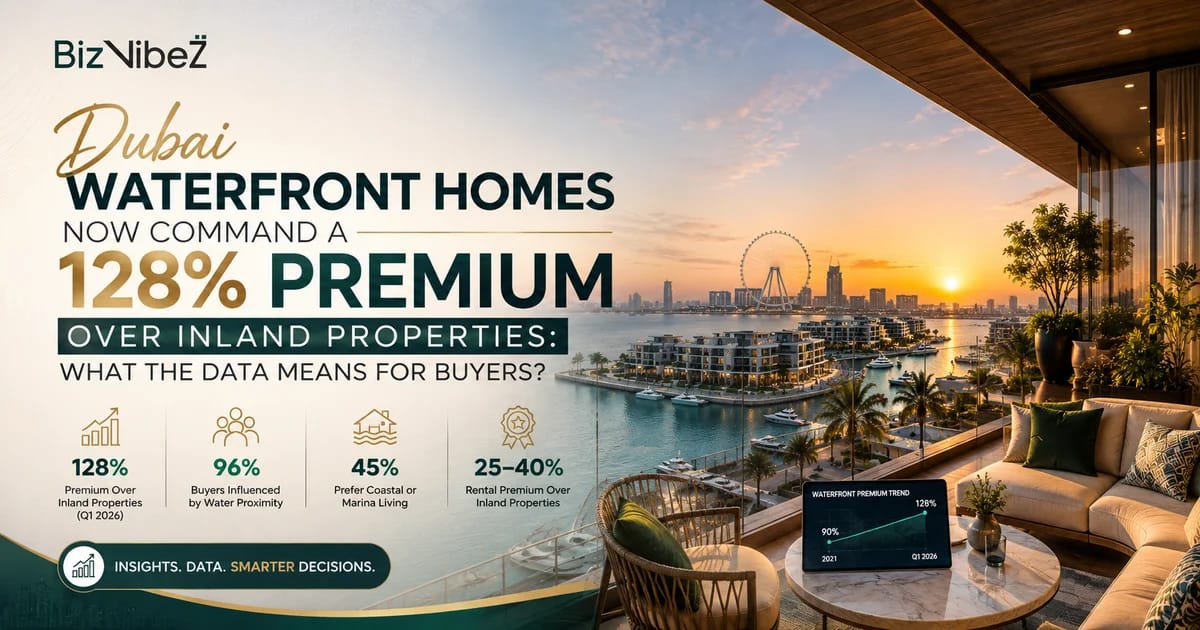
Dubai Waterfront Homes Now Command a 128% Premium Over Inland Properties: What the Data Means for Buyers
Date: 05-08-2026
Dubais waterfront property premium has nearly doubled in five years. Waterfront homes commanded a 90% premium over comparable inland properties in 2021. By Q1 2026, that gap had widened to 128%, according to The Future of Seafront Being report produced by White Paper Media Consulting for Shamal Holding, published in July 2026.
This is not a temporary spike driven by a single transaction or a marketing-inflated claim. It reflects a sustained, structural shift in buyer preference backed by survey data, transaction records, and Knight Franks independent MENA research confirming that waterfront communities remained among the strongest-performing residential markets in H1 2026.
The 128% premium means a buyer choosing a waterfront property over a comparable inland unit in the same city is paying more than twice as much for the seafront address on average. For investors, that premium needs to be weighed against rental uplift, capital resilience in corrections, and the supply constraint that sustains it.
For end-users, it reflects a genuine and measurable shift in what the market defines as luxury. This breakdown explains what is driving the premium, where it is concentrated, which communities deliver the strongest combination of waterfront access and investment fundamentals, and what buyers must evaluate before committing.
Where does the 128% Premium Come From?
The premium exists because of a simple imbalance: Dubais coastline and waterfront access are finite, while the citys population and international buyer base continue to grow. The DLD reported over 208,000 new residents relocating to Dubai in 2025 alone, with buyers aged 31 to 45 accounting for the majority of purchases.
This demographic, career-stable, family-forming, and increasingly wealth-conscious, consistently prioritises quality of life factors in purchase decisions, of which waterfront access ranks at the top.
The Shamal Holding report surveyed Dubai residents and property buyers directly. Among respondents, 96% said proximity to water influences their daily decisions, from how they exercise to where they spend their leisure time. 88% believe living near the sea improves both mental and physical wellbeing.
48% now regard proximity to the seafront as the most important marker of modern luxury, ahead of both prestige branding and design quality. 45% identified coastal and marina environments as their preferred residential setting, ahead of high-density urban communities. These are not aspirational preferences. They are active purchase drivers reflected in transaction data.
| Waterfront Premium Indicator | 2021 | Q1 2026 | Change |
|---|---|---|---|
| Average premium over comparable inland property | 90% | 128% | +38 percentage points over 5 years |
| Buyers ranking seafront as most important luxury marker | Not measured | 48% | Now ahead of prestige and design trends |
| Buyers preferring coastal or marina residential setting | Not measured | 45% | Ahead of high-density urban communities |
| Residents reporting water proximity affects daily decisions | Not measured | 96% | Including exercise, leisure, and spending choices |
| Residents believing seafront living improves wellbeing | Not measured | 88% | Mental and physical wellbeing cited |
| Coastal property rental premium over inland equivalents | 25–40% (DLD data) | Sustained or widening | Supported by scarcity and demand growth |
Which Communities Are Leading the Waterfront Market in 2026?
Dubais waterfront supply is distributed across several distinct corridor types: ocean-facing and beach-access communities, marina and canal communities, and creek and lagoon developments. Each carries a different premium profile, a different buyer profile, and a different supply pipeline.
| Community | Water Type | H1 2026 Performance | Typical Buyer Profile | Supply Constraint Level |
|---|---|---|---|---|
| Palm Jumeirah | Ocean-facing, beach access | 50 ultra-luxury transactions above AED 36.7m in H1 2026 (Knight Frank); among strongest H1 luxury performers | Ultra-HNW international buyers, wealth preservation | Very high; fixed island supply, no expansion possible |
| Dubai Marina | Marina canal, JBR beachfront proximity | Established yields 6–8%; high occupancy, tourism-driven short-term demand | Mixed: investors, residents, short-term rental operators | Moderate; built-out, limited new supply |
| Emaar Beachfront | Beach access, Arabian Gulf | Off-plan and ready units; strong demand from end-users and investors | Premium buyers seeking managed beach community | Low; phased delivery with limited total units |
| Dubai Creek Harbour | Creek, Dubai Island proximity | Active; off-plan dominant; Metro Blue Line station arriving 2029 | Growth investors, global off-plan buyers | Low; large master development with phased supply |
| Palm Jebel Ali | Ocean-facing, new island | 40 ultra-luxury transactions above AED 36.7m in H1 2026 ahead of 2028 completion | Trophy buyers, long-horizon investors | Extremely high; new fronds, early stage |
| Dubai Islands | Coastal, northern Dubai | Emerging; off-plan launches active; limited ready stock | Early-stage investors, beach-lifestyle buyers | Low to moderate; new coastline under development |
| Dubai Harbour | Marina, cruise terminal proximity | Growing; mixed residential and hospitality | Lifestyle buyers, yield investors | Moderate; still developing |
Why Does Premium Have Durability That Other Luxury Segments Lack?
The 128% premium is not simply a function of desirability. It reflects a supply dynamic that other luxury segments, such as branded residences or high-floor premium apartments, do not share to the same degree. Dubais coastline is geographically finite. Palm Jumeirah cannot be expanded.
The JBR beach frontage is fixed. Emaar Beachfronts unit count is capped by the development plan. New waterfront supply, such as Dubai Islands and Palm Jebel Ali, requires years of infrastructure development before delivering occupiable units.
This supply constraint produces a different price resilience profile than inland luxury during market corrections. During Dubais 2014 to 2020 softening cycle, waterfront communities held value more tenaciously than inland premium towers because international wealth-preservation buyers who dominate the waterfront segment are less sensitive to local market sentiment cycles than yield-focused investors.
The same dynamic was visible in Q2 2026: while overall transaction volumes declined 19% quarter-on-quarter, ultra-luxury waterfront communities, Palm Jumeirah, Palm Jebel Ali, and Dubai Hills Estate recorded their strongest H1 luxury transaction counts on record, according to Knight Frank and Edwards and Towers.
The Wellbeing Premium Is Now Measurable
Dubais broader property market has begun explicitly pricing the wellbeing dimension of waterfront living rather than treating it as an intangible. The Shamal Holding report, backed by Knight Frank MENAs Shehzad Jamal, articulates a structural shift from waterfront as location premium to waterfront as integrated lifestyle infrastructure. Communities that combine direct water access with walking promenades, beach clubs, marine activities, and public waterfront space are commanding the strongest premiums within the waterfront segment itself. This convergence of physical access, community design, and wellbeing infrastructure is what separates top-tier waterfront communities from those that offer proximity to water without daily integration with it.
What to Evaluate Before Paying the Waterfront Premium?
A 128% average premium covers a wide range of actual transactions. Some waterfront units deliver every component of the premium on a sustained basis. Others carry the label without the access, supply scarcity, or community infrastructure that makes the premium durable. The following factors separate justified waterfront premiums from overpriced water view listings:
- Access type, not view type. Direct beach, marina, or canal access is the premium driver. A high-floor apartment with a partial sea view in a non-waterfront tower does not belong in the same valuation category as a low-rise unit in a master-planned waterfront community with private beach access. Confirm the specific access type before evaluating whether the premium is comparable to the market benchmark.
- Community supply cap. Fixed-supply waterfront communities, where no additional units can physically be added, hold premiums more reliably over time than communities where additional waterfront phases are still planned. Check the master plan for the remaining pipeline before assuming current scarcity will persist.
- Waterfront infrastructure quality. The premium is sustained by the quality of the waterfront experience, not just the proximity. Beach clubs, promenades, marine activity infrastructure, and waterfront F&B are the amenities that drive repeat demand and rental premium. Evaluate these directly, not from marketing materials.
- Rental versus end-use premium. Waterfront communities command a 25–40% rental premium over inland equivalents for comparable unit types, according to DLD data. For investors, the yield profile should be modelled against this premium specifically, not against citywide averages that blend waterfront and inland rental data.
- Correction resilience track record. The premiums durability through Dubais 2014 to 2020 softening cycle is the most relevant historical precedent. Buyers paying a 128% premium should assess whether the specific communitys actual transaction data supports correction resilience, not just whether waterfront as a category held value on average.
How BizVibez Consultants Supports Waterfront Property Buyers?
High-value waterfront transactions involve residency, legal, banking, and compliance requirements that sit alongside the purchase decision. BizVibez Consultants provides structured support across the most relevant areas:
- Golden Visa UAE: Guidance on 10-year UAE residency eligibility tied to qualifying property investment thresholds, including premium waterfront communities in designated freehold zones.
- Legal Services: Review of sale and purchase agreements, title documentation, and DLD registration requirements before committing to any waterfront or coastal property transaction.
- Bank Account Opening in UAE: Support establishing UAE banking access required to manage high-value property payments, rental income, and ongoing service charge obligations.
- Compliance Services: Ongoing alignment with DLD registration requirements and federal regulatory obligations relevant to property ownership, rental structures, and income management.
What the 128% Premium Means for Your Property Decision?
Dubais waterfront premium has grown from 90% to 128% in five years because the supply of genuine waterfront access is structurally finite while demand from a growing, increasingly wealthy resident and international buyer population continues to expand. The premium is not uniform, and not every property marketed as waterfront deserves to be priced against the 128% benchmark.
The buyers who sustain the premium are those with genuine daily water access, supply-constrained community positions, and the quality of waterfront infrastructure that makes the lifestyle dimension real rather than incidental. Buyers evaluating whether to pay the premium should verify access type, community supply cap, infrastructure quality, and correction-period transaction data specific to the community rather than relying on the citywide average as a universal justification.
Get Guidance on Your Waterfront Property Decision
Residency, legal documentation, and banking access are the practical steps that follow any waterfront property decision. BizVibez Consultants can be reached directly at info@bizvibez.com or +971 55 424 8875 to discuss Golden Visa eligibility, legal review of purchase terms, or banking requirements relevant to a waterfront or coastal property transaction in Dubai.