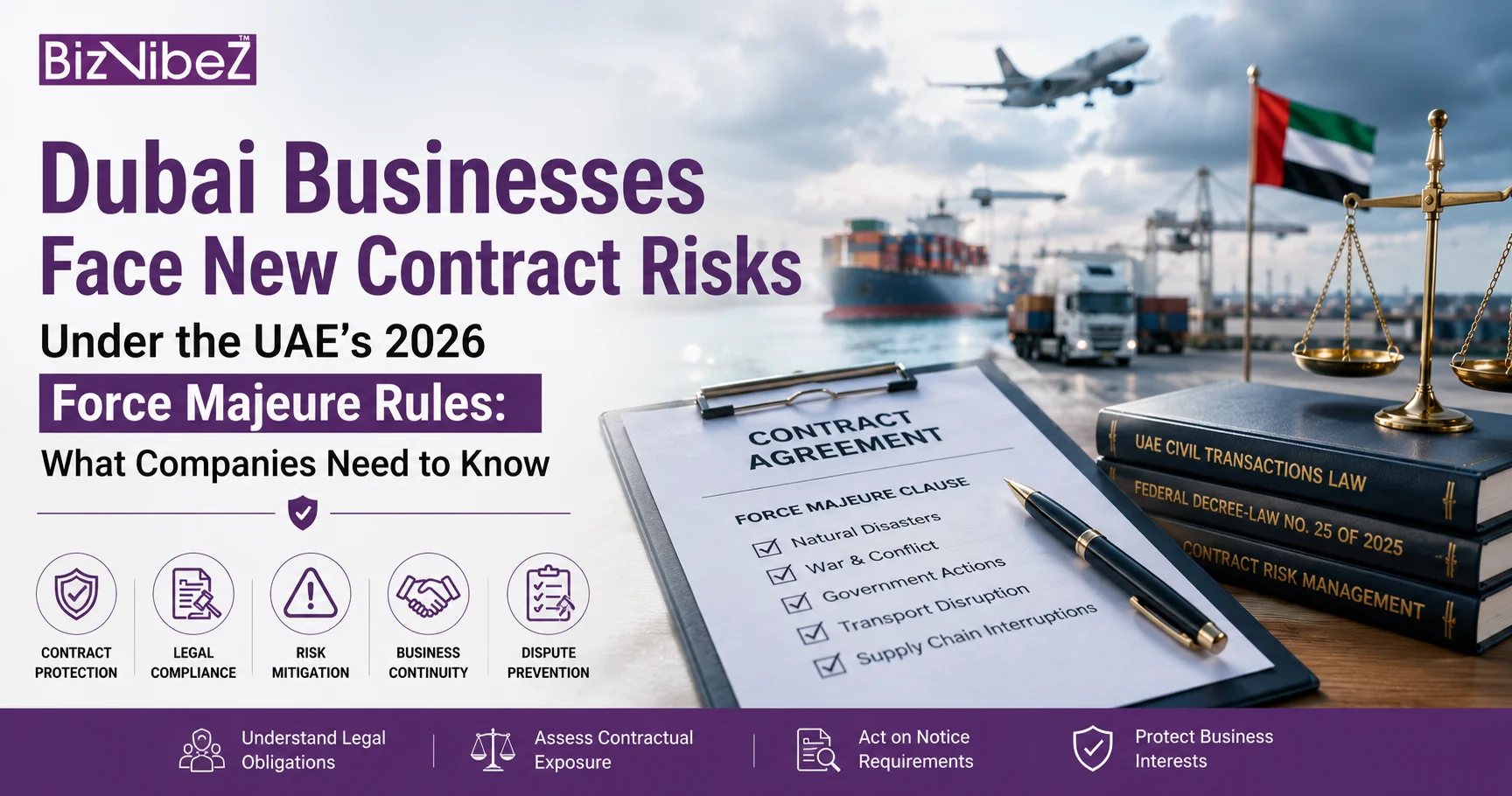
Dubai Businesses Face New Contract Risks Under the UAEs 2026 Force Majeure Rules: What Companies Need to Know
Date: 01-09-2026
Dubai businesses should review force majeure clauses and other disruption provisions following the UAEs new Civil Transactions Law, Federal Decree-Law No. 25 of 2025, which took effect on 1 June 2026. The new law retains the core rule that total impossibility caused by force majeure can end reciprocal contractual obligations, while adding clearer treatment for partial and temporary impossibility and broader relief for certain exceptional circumstances.
The practical risk is not simply whether an event qualifies as force majeure. Companies must establish a direct connection between the event and the failed obligation, follow contractual notice requirements, preserve evidence and distinguish genuine impossibility from higher costs or commercial inconvenience. Current regional disruption makes these checks particularly important for Dubai companies dependent on shipping, construction materials, aviation or cross-border supply chains.
What changed under the 2026 rules?
The new Civil Transactions Law replaced the previous 1985 Civil Code from 1 June 2026. Article 236 addresses force majeure where performance becomes impossible in bilateral contracts and provides specific treatment for total, partial and temporary impossibility.
| Situation affecting the contractual obligation | Treatment under Article 236 | Practical implication |
|---|---|---|
| Performance becomes completely impossible | Corresponding obligations are extinguished and the contract may be rescinded automatically | Parties should document why performance became objectively impossible |
| Performance becomes partially impossible | A party may invoke extinguishment of the affected obligation or seek rescission through the court | Identify precisely which obligation is affected |
| Performance becomes temporarily impossible in a continuing contract | A party may invoke extinguishment or modification of the affected obligation or seek rescission | Temporary disruption does not necessarily justify immediate termination |
| Performance becomes more expensive but remains possible | Force majeure may not apply simply because performance is commercially difficult | Consider contractual hardship or adjustment provisions instead |
The distinction matters because UAE law has traditionally applied a demanding test to force majeure. Mere increased expense, delay or inconvenience does not automatically establish impossibility.
Why Dubai companies face greater contract exposure?
Regional disruption has made contractual dependencies more visible. Reuters reported in August 2026 that only five commodity vessels transited the Strait of Hormuz on one reported day, compared with a 10-day average of 15. The route normally carries a major share of global energy shipments.
The effect extends beyond energy businesses. A Dubai importer may face delayed components, a contractor may struggle to obtain materials, and a service provider may encounter travel or regulatory restrictions. However, the existence of a regional crisis does not by itself release a company from every contractual obligation.
Recent market conditions show why businesses should examine their contracts before problems become disputes. A July 2026 Reuters poll found economists expected the UAE economy to contract slightly in 2026 because of prolonged regional disruption, while higher shipping costs and weaker confidence affected Gulf economies.
The Abu Dhabi statistics authority also published a first-quarter 2026 Construction Cost Index, demonstrating the importance of monitoring construction-related cost and market movements when assessing contractual exposure.
How force majeure claims should be assessed?
Start with the actual contract
A force majeure clause can define the events covered, required notices, mitigation duties and available remedies. UAE law generally allows parties to agree contractual terms provided they do not conflict with mandatory law or public order.
A clause that specifically addresses war, government restrictions, transport disruption, embargoes or supply interruptions may therefore operate differently from a narrowly drafted clause.
Prove the causal connection
The company invoking force majeure should be able to show:
- What event occurred
- When it occurred
- Which contractual obligation was affected
- Why the event prevented performance
- What reasonable mitigation steps were attempted
- What evidence supports the claim
The stronger the causal chain, the easier it becomes to distinguish a genuine force majeure event from ordinary commercial risk.
Act quickly on notice requirements
Many commercial contracts require written notice within a defined period. Missing that requirement can undermine an otherwise arguable claim. Construction contracts can be particularly strict about notice and supporting records.
Keep a disruption file containing supplier correspondence, transport records, government notices, delivery schedules, revised timelines and internal mitigation decisions. Creating the record during the event is more reliable than reconstructing it months later.
Force majeure is not the same as hardship
The new Civil Transactions Law also strengthens the framework for exceptional circumstances where performance becomes excessively onerous rather than impossible. Articles 224 and 829 can provide routes for judicial intervention in qualifying circumstances, including certain construction relationships.
| Contract problem | More relevant legal concept | Typical question to ask |
|---|---|---|
| Performance cannot objectively occur | Force majeure | Has an external event made the obligation impossible? |
| Only part of performance is impossible | Partial impossibility | Which specific obligation cannot be performed? |
| Temporary interruption affects an ongoing contract | Temporary impossibility | Can performance resume after the disruption? |
| Performance remains possible but becomes exceptionally burdensome | Hardship or exceptional circumstances | Has the contractual balance been seriously disrupted? |
This distinction prevents companies from treating every cost increase or delay as a force majeure event.
Things to Consider Before Making a Decision
Before terminating, suspending performance or issuing a force majeure notice, review:
- Contract date and governing law because the new Civil Transactions Law took effect on 1 June 2026 and transitional issues can matter for older arrangements.
- Exact clause wording covering force majeure, hardship, delay, termination and notice.
- Dispute resolution mechanism to determine whether disputes go before a court or arbitral tribunal.
- Mitigation obligations and whether alternative suppliers, routes or performance methods were reasonably available.
- Evidence quality showing the event actually caused the failure to perform.
- Risk allocation because a contract may already assign certain supply, transport or regulatory risks to one party.
Practical contract choices for Dubai businesses
| Contract approach | Best suited for | Key protection |
|---|---|---|
| Detailed force majeure clause | Contracts exposed to external disruptions | Defines covered events and procedures |
| Hardship or adjustment mechanism | Long-term contracts exposed to major market changes | Creates a route for contractual rebalancing |
| Specific notice procedure | Projects with strict claims management | Reduces uncertainty around claim timing |
| Alternative performance provisions | Supply and service agreements | Provides practical options when the original method fails |
Relevant support for contract risk management
BizVibez Consultants can support businesses with closely related administrative and compliance requirements:
- Legal Services
Supports businesses dealing with legal and contractual administration where specialist review is required. - Compliance Services
Helps maintain organized compliance processes and records relevant to ongoing business obligations. - Operational Services
Supports businesses in organizing operational documentation and processes during periods of disruption. - Mail Management
Helps maintain reliable handling of important business correspondence and notices.
Keep contracts ready for future disruption
The 2026 framework gives Dubai businesses clearer rules around total, partial and temporary impossibility, but it does not create an automatic escape from contractual obligations. Companies should focus on the wording of each agreement, the precise effect of the disruptive event, notice requirements and the evidence supporting causation.
A practical contract review before a disruption occurs is usually more effective than trying to interpret rights after a dispute has already developed.
Get the contract position reviewed
For businesses that need help organizing the administrative and compliance side of contractual risk, seamlessly integrating legal services ensures your agreements are safeguarded properly. BizVibez Consultants can be contacted at info@bizvibez.com or +971 55 424 8875. The appropriate next step should depend on the contract, governing law, nature of the disruption and the companys specific obligations.