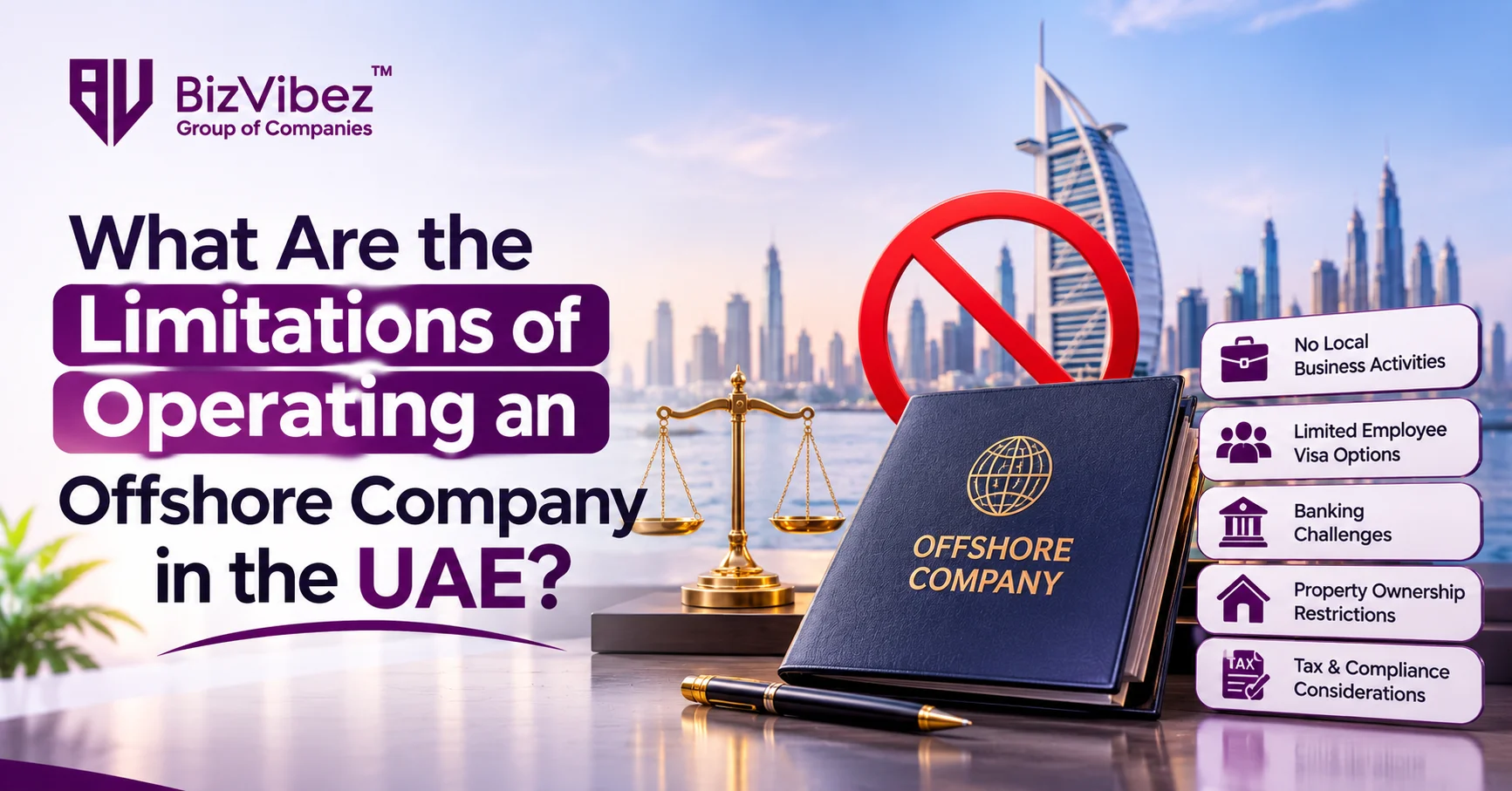
What Are the Limitations of Operating an Offshore Company in the UAE?
Date: 08-11-2026
A UAE offshore company can provide an effective structure for international investments, asset holding and cross-border business arrangements. However, it does not offer the same operational flexibility as a mainland or free zone company. Offshore entities generally cannot conduct ordinary commercial activities directly within the UAE market, obtain a standard business licence, or sponsor employees through the usual company visa arrangements. These restrictions make it important to understand the structure before choosing it for business purposes.
The limitations of operating an offshore company in the UAE depend on its registration jurisdiction, permitted activities and applicable regulations. Although offshore companies can hold certain assets, own shares in other entities and maintain international business relationships, they must follow specific legal, banking, tax and administrative requirements. Understanding these restrictions helps investors determine whether an offshore structure supports their long-term business objectives.
1. Restrictions on Conducting Business Within the UAE
One of the main limitations of a UAE offshore company is its restricted access to the local business market. Unlike mainland companies, offshore entities are generally established for international operations and cannot conduct ordinary commercial activities directly with UAE residents or businesses without the necessary local licensing arrangements.
For example, an entrepreneur planning to operate a retail shop, provide local consultancy services, or sell products directly to UAE customers may need a mainland or appropriately licensed free zone company instead.
The following table explains common operational restrictions.
| Business Activity | General Offshore Company Position |
|---|---|
| International business transactions | Generally permitted, subject to jurisdictional rules |
| Direct retail operations in the UAE | Not generally permitted |
| Operating a local restaurant or shop | Requires an appropriate local licence |
| Providing services directly in the UAE market | Requires applicable licensing or regulatory approval |
| Holding shares in other companies | Generally permitted, subject to regulations |
| Owning qualifying UAE property | Permitted in designated areas, subject to applicable rules |
| Operating a physical commercial establishment | Requires appropriate licensing |
Investors should verify permitted activities with the relevant offshore authority before incorporating their companies.
2. Limited Access to UAE Business Licensing
An offshore company is not equivalent to a mainland or free zone business with a conventional commercial licence. Depending on the jurisdiction, the company may receive a certificate of incorporation rather than a licence authorising local commercial operations.
This distinction affects the activities the company can legally perform within the UAE. An offshore entity cannot assume that incorporation automatically grants permission to provide regulated services, establish a local trading operation, or enter every type of commercial arrangement.
Before registration, investors should review the following requirements.
| Licensing Consideration | What Investors Should Understand |
|---|---|
| Certificate of incorporation | Confirms the companys legal registration |
| Commercial licence | Offshore incorporation does not generally provide a local trading licence |
| Regulated activities | May require separate approval from the competent authority |
| Local business operations | Require an appropriate legal structure and licence |
| Jurisdictional permissions | Activities vary according to the offshore registrar |
Choosing a structure based only on its registration benefits can create operational difficulties later.
3. Restrictions on Employee Visas and UAE Residency
Another important limitation concerns employee recruitment and visa sponsorship. Offshore companies generally do not have the standard employment visa quota available to mainland and many free zone businesses.
This can create difficulties for entrepreneurs who intend to establish a team, recruit employees, or maintain a regular workforce in the UAE.
Investors should distinguish between company ownership and personal residency because registering an offshore company does not automatically provide a UAE residence visa.
| Requirement | Offshore Company Consideration |
|---|---|
| Employee sponsorship | Generally unavailable through the standard offshore company structure |
| Employment visa quota | Not normally provided |
| Shareholder residency | Depends on the jurisdiction and applicable arrangements |
| Employee recruitment | Requires an appropriate licensed employer |
| Personal residence visa | Must be obtained through an eligible immigration route |
Individuals who need UAE residency can explore separate eligible options, such as employment-based, freelance, or other qualifying residence visa arrangements. Eligibility depends on the relevant authority and individual circumstances.
4. Challenges in Opening a Corporate Bank Account
Although a UAE offshore company may be eligible to apply for a corporate bank account, approval is not automatic. Banks conduct their own due diligence to understand the companys ownership, business activities, expected transactions and source of funds.
Offshore structures may receive additional scrutiny because banks need to establish the commercial purpose of the entity and identify its ultimate beneficial owners.
Common banking challenges include:
- Providing sufficient evidence of the companys business activities.
- Verifying shareholder and director identities.
- Explaining the source of funds and expected transaction patterns.
- Providing contracts, invoices, or supporting business documents.
- Meeting the banks compliance and risk assessment requirements.
| Banking Requirement | Common Supporting Information |
|---|---|
| Company identification | Certificate of incorporation and constitutional documents |
| Ownership verification | Shareholder register and beneficial ownership information |
| Identity verification | Passport and address documentation |
| Business background | Business profile and activity explanation |
| Source of funds | Supporting financial and commercial records |
| Transaction assessment | Expected payment volumes, countries and counterparties |
Each bank applies its own onboarding policies. Therefore, investors should not treat offshore incorporation as a guarantee of corporate bank account approval.
5. Restrictions on Property Ownership and Asset Activities
UAE offshore companies may be permitted to hold certain assets, including shares in other companies and qualifying real estate. However, property ownership is not unrestricted across every emirate or location.
The ability to purchase or hold property depends on the applicable offshore jurisdiction, land registration requirements and the rules governing foreign ownership in the relevant area.
Investors should review these considerations before using an offshore entity as a property-holding structure.
| Asset-Related Consideration | Limitation or Requirement |
|---|---|
| Dubai real estate | Ownership is subject to approved ownership areas and applicable registration rules |
| Property in other emirates | Depends on the relevant emirates property ownership framework |
| Shares in UAE companies | Subject to company law and ownership requirements |
| Intellectual property | Must comply with relevant registration and ownership rules |
| Asset transfers | May require supporting legal documents and approvals |
An offshore company should not be assumed to have unrestricted rights to purchase, lease, or commercially operate property in the UAE.
6. Corporate Tax and Regulatory Compliance Responsibilities
Offshore incorporation does not automatically exempt a company from every UAE or foreign tax obligation. Corporate tax treatment depends on the companys legal status, activities, income, applicable tax rules and relevant exemptions.
Companies should assess whether they fall within the scope of UAE corporate tax requirements and whether registration, filing, or other obligations apply.
Similarly, maintaining accurate corporate records, ownership information and statutory documents remains important even when the company has limited day-to-day operations.
| Compliance Area | What Companies Should Review |
|---|---|
| Corporate tax | Whether the entity falls within the applicable tax framework |
| Tax registration | Whether registration requirements apply |
| Tax returns | Whether filing obligations arise |
| Beneficial ownership | Accuracy and maintenance of ownership records |
| Accounting records | Retention of appropriate financial documentation |
| Annual renewal | Compliance with the relevant registrars renewal requirements |
| Foreign tax obligations | Tax exposure in countries where the company operates or earns income |
Businesses should obtain professional tax advice rather than assume that an offshore structure automatically provides a zero-tax position.
7. Limited Physical Presence and Operational Flexibility
Offshore companies are generally designed to operate without maintaining a conventional commercial office in the UAE. While this can reduce administrative requirements, it may also limit their ability to establish a visible local business presence.
Companies that need dedicated premises, local staff, customer-facing operations, or regular business facilities may find this structure unsuitable.
For instance, a business planning to conduct frequent local meetings, manage employees, or provide services from a UAE office may require a different company formation arrangement.
8. Jurisdiction-Specific Rules and Administrative Requirements
UAE offshore companies are not all governed by identical rules. Different registration authorities have their own incorporation procedures, documentation requirements, permitted activities and ongoing compliance conditions.
For example, Jebel Ali Free Zone (JAFZA) requires offshore company registration applications to be processed through its registered agents. Other jurisdictions may apply different administrative arrangements.
Investors should compare the relevant requirements before selecting a registration authority.
| Consideration | Why It Matters |
|---|---|
| Registration authority | Determines the applicable offshore regulations |
| Registered agent | May be mandatory for incorporation and administration |
| Shareholder requirements | Can differ between jurisdictions |
| Director requirements | Depend on the applicable regulations |
| Registered office | Must satisfy the relevant authoritys rules |
| Annual renewal | Requirements and procedures vary |
| Permitted activities | Must be confirmed with the registrar |
Things to Consider Before Choosing a UAE Offshore Company
Before establishing an offshore company, investors should assess whether its restrictions align with their intended business model. A structure suitable for holding international investments may not be appropriate for operating a local consultancy, employing staff, or selling products within the UAE.
Consider the following factors:
- Business objectives: Determine whether the company will hold assets, manage investments, or conduct international transactions.
- Target market: Identify whether customers will be located inside or outside the UAE.
- Banking requirements: Assess the documentation and due diligence requirements of potential banks.
- Residency needs: Establish whether shareholders or employees require UAE residence visas.
- Tax responsibilities: Review applicable corporate tax and international reporting obligations.
- Future expansion: Consider whether a mainland or free zone structure would provide greater operational flexibility.
How BizVibez Consultants Supports Offshore Business Requirements
Choosing an appropriate business structure requires an understanding of licensing restrictions, documentation, banking procedures and ongoing compliance responsibilities. BizVibez Consultants helps investors assess relevant business setup requirements and identify suitable administrative support.
Relevant services include:
- Bank Account Opening in UAE: Assistance with understanding corporate banking documentation and application requirements.
- Compliance Services: Support with relevant corporate documentation and compliance procedures.
- Legal Services: Guidance on company-related legal documentation and applicable requirements.
- Operational Services: Administrative support for business-related operational requirements.
The appropriate support depends on the companys jurisdiction, activities and regulatory obligations.
Final Thoughts
A UAE offshore company can be suitable for international asset holding, investment structures and cross-border business arrangements. However, restrictions on local trading, commercial licensing, employee sponsorship, banking approval and operational presence can limit its usefulness for businesses seeking to operate directly in the UAE.
Investors should evaluate these limitations before registration and compare offshore, mainland and free zone structures according to their actual business requirements. BizVibez Consultants can assist with understanding relevant setup, banking, legal and compliance requirements so that business owners can make informed decisions.
Contact BizVibez Consultants
- Phone: +971 44 569 917
- Email: info@bizvibez.com
- Website: https://www.bizvibez.com/