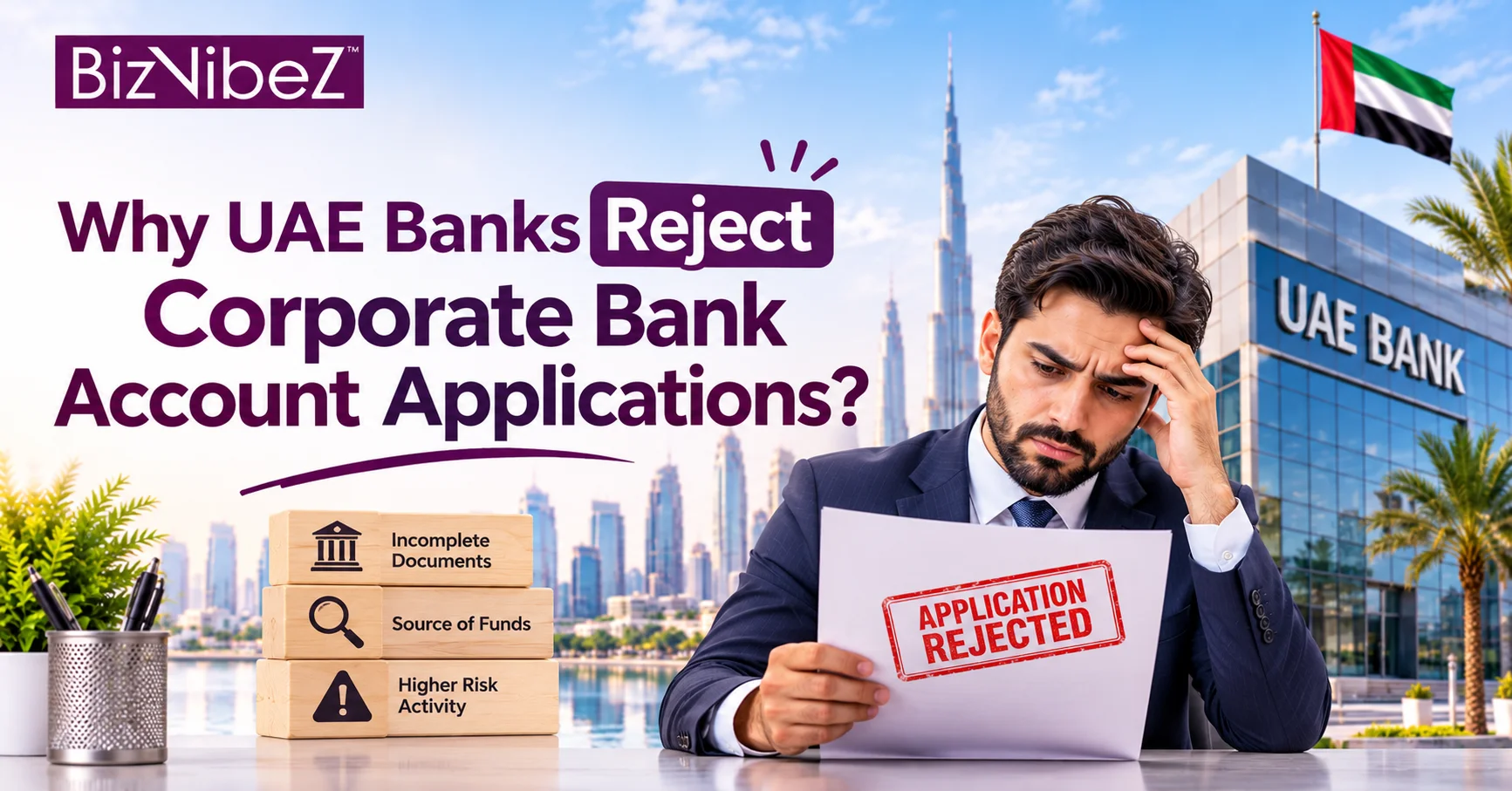
Why Do UAE Banks Reject Corporate Bank Account Applications?
Date: 12-11-2026
UAE banks usually reject or delay a corporate bank account application because they cannot complete their due diligence on the company. The most common causes are incomplete or inconsistent documents, an unclear source of funds, ownership that is hard to trace, and a business activity or connected country that the bank treats as higher risk. Most of these issues can be identified and fixed before the application is submitted.
For new company owners, a bank account is often the step that takes longest after the trade licence is issued. Understanding what banks are required to check, and why, makes it easier to prepare an application that a compliance team can approve.
What Are UAE Banks Required to Check?
Banks in the UAE must follow the federal anti-money laundering framework. The current law is Federal Decree-Law No. 10 of 2025, which replaced Federal Decree-Law No. 20 of 2018. Its Executive Regulations, issued under Cabinet Decision No. 134 of 2025, took effect on 14 December 2025.
Under this framework and the Central Bank of the UAE (CBUAE) guidance on customer due diligence, a bank must:
- Identify and verify the company, its shareholders and its authorised signatories.
- Identify the beneficial owner, meaning any natural person who owns or controls 25% or more of the company, directly or indirectly.
- Understand the nature of the business and the purpose of the account.
- Understand the ownership and control structure, tracing it up the chain where companies own companies.
- Collect evidence of source of funds, and of source of wealth, for higher risk relationships.
- Monitor the account on an ongoing basis, with reviews scaled to the customer's risk rating.
The CBUAE guidance also states that banks should not open or maintain a relationship with a customer who is unable or unwilling to provide the required due diligence information. In practice, this is why a missing document or an unclear answer can stop an application entirely.
What Are the Most Common Reasons for Rejection?
Banks rarely publish detailed reasons for individual decisions, but the factors below are consistently cited by UAE banks, regulators and licensing authorities.
| Reason | Why it concerns the bank |
|---|---|
| Incomplete or inconsistent documents | Names, addresses, activities or shareholdings that do not match across the licence, Memorandum of Association and passports prevent the bank from verifying the company |
| Unclear source of funds | The bank cannot confirm where the opening deposit and expected turnover will come from |
| Complex ownership structure | Several layers of holding companies make it difficult to identify the beneficial owner |
| Higher risk business activity | Cash-intensive businesses, virtual assets and some trading and financial activities attract enhanced due diligence |
| Higher risk countries | Shareholders, suppliers or customers connected to high risk or sanctioned jurisdictions require additional checks |
| No operating history | A newly formed company has no track record, so the bank relies heavily on the business plan and the owners' background |
| Non-resident owners or signatories | Owners who live outside the UAE trigger additional checks, and some banks require at least one UAE resident signatory |
Senior business banking executives quoted by Gulf News in July 2026 noted that many delays relate to incomplete or inconsistent documentation rather than to compliance concerns about the business itself.
Is the UAE Still on the FATF Grey List?
No. The Financial Action Task Force removed the UAE from its list of jurisdictions under increased monitoring in February 2024. However, banks still apply enhanced checks to customers connected to countries that remain on FATF lists, so the nationality and residence of owners, and the countries the company trades with, still matter.
What Documents Do UAE Banks Usually Ask For?
There is no single official document list for every bank. Requirements vary by bank, licensing authority and business activity. The table below reflects documents commonly requested by UAE banks and free zone authorities.
| Document | Purpose |
|---|---|
| Trade licence | Confirms the company is licensed and shows its approved activities |
| Memorandum and Articles of Association | Shows ownership, capital and management, including any amendments |
| Share certificate or register of shareholders | Confirms who owns the company and in what proportion |
| Beneficial owner declaration | Identifies every natural person with 25% or more ownership or control |
| Board resolution or power of attorney | Names the authorised signatories for the account |
| Passports, visas and Emirates IDs | Identifies shareholders, managers and signatories |
| Proof of address | A tenancy contract or Ejari, or the free zone lease or flexi desk agreement |
| Company profile and owners' CVs | Explains the business model and the owners' experience |
| Bank statements of the owners | Supports the source of funds, often for the previous six months |
Corporate shareholders usually need an additional pack, such as a certificate of incorporation, an incumbency certificate and their own ownership documents.
What Has Changed for SME Account Opening in 2026?
The CBUAE SME Customer Protection Regulation took effect on 13 September 2026, replacing the earlier SME Market Conduct Regulation. It sets clearer expectations for how banks handle account applications from small and medium-sized businesses.
| Requirement | What it means for applicants |
|---|---|
| Timeline for low risk applicants | Accounts should be opened within three business days once all required documents are submitted, where the applicant is assessed as low risk |
| Other delays | Delays for reasons other than financial crime compliance must be explained and should not exceed two weeks |
| Document disclosure | Banks must clearly disclose their minimum documentary requirements and provide a list of required documents |
| Fair treatment | Applications must not be rejected on discriminatory grounds |
| Transactions | No transactions are allowed until due diligence, including sanctions screening, is complete |
The three day timeline only starts once the bank has every document it asked for, and it can be extended for financial crime compliance reasons. A complete, consistent file is therefore the most practical way to benefit from the new rules.
How to Avoid a Corporate Bank Account Rejection
Preparation matters more than the choice of bank. The following steps address the issues that most often delay or stop an application.
- Check every document for consistency: Make sure company names, shareholder names, passport numbers, addresses and shareholdings match exactly across the licence, Memorandum of Association, share certificate and identification documents.
- Match the licence to the real business: Choose specific activities that describe what the company will actually do. A vague or very broad activity is harder for a bank to assess.
- Prepare a clear source of funds: Show where the initial capital and expected income will come from, with bank statements, sale agreements, salary records or other evidence.
- Simplify or document the ownership: If the company is owned through other companies, prepare a clear ownership chart and the corporate documents for every layer up to the beneficial owners.
- Explain the business model: A short business plan with expected turnover, main suppliers and customers, and the countries involved helps the compliance team understand the account's expected activity.
- Keep your beneficial owner register up to date: Under Cabinet Decision No. 109 of 2023, UAE companies must keep a beneficial owner register and update it within 15 days of any change.
- Choose a bank that suits your profile: Banks differ in the activities, nationalities and residency status they accept. Applying to a bank that matches your profile reduces the risk of a decline.
What Should You Do If Your Application Is Rejected?
A rejection from one bank does not mean every bank will decline the company. Before applying again, review the likely reason, correct inconsistent documents, strengthen the source of funds evidence and consider whether another bank is better suited to the business activity and ownership profile. Applying to several banks at once with the same unresolved issues is unlikely to help.
How BizVibez Consultants Supports Corporate Bank Account Applications
Preparing a corporate bank account application involves understanding what each bank's compliance team needs and presenting the company clearly and consistently.
BizVibez Consultants provides banking assistance alongside company formation and ongoing corporate services. The firm's founder brings more than two decades of corporate and investment banking experience to its advisory work.
Its relevant services include:
- Bank Account Opening: Guidance on document preparation, bank selection and the application process.
- Company Formation: Mainland, free zone and offshore company setup with activities that match the business.
- PRO Services: Support with licences, visas and Emirates IDs for shareholders and signatories.
- Accounting and Tax Compliance: Support with financial records and tax registrations that banks may request during reviews.
For enquiries about opening a corporate bank account, business owners can contact BizVibez Consultants to discuss their circumstances.
Conclusion
Most corporate bank account rejections in the UAE come down to due diligence the bank cannot complete. Consistent documents, a clear source of funds, a transparent ownership structure and a well explained business model address the majority of these concerns.
Bank requirements differ and change over time, so applicants should confirm the latest document list with their chosen bank before applying. BizVibez Consultants can help business owners prepare a complete application and choose a bank that suits their profile.
Contact BizVibez Consultants
- Website: BizVibez Consultants
- Phone: +971 44 569 917
- WhatsApp: +971 54 201 9999
- Email: info@bizvibez.com